Earth and Space Sciences Regents, August 2026, question 40
Tap an image to open it full size.
What the figure shows
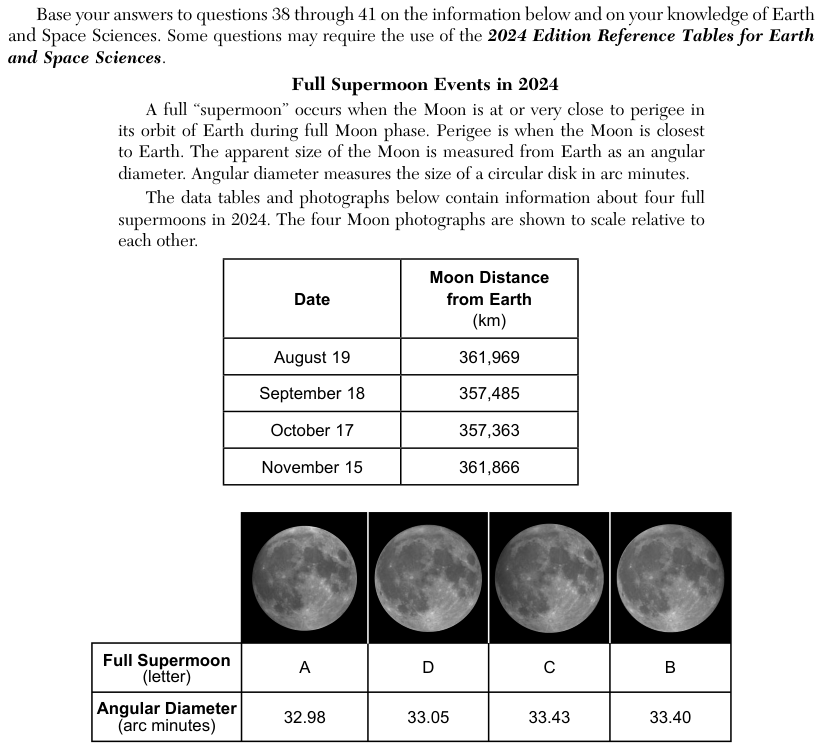
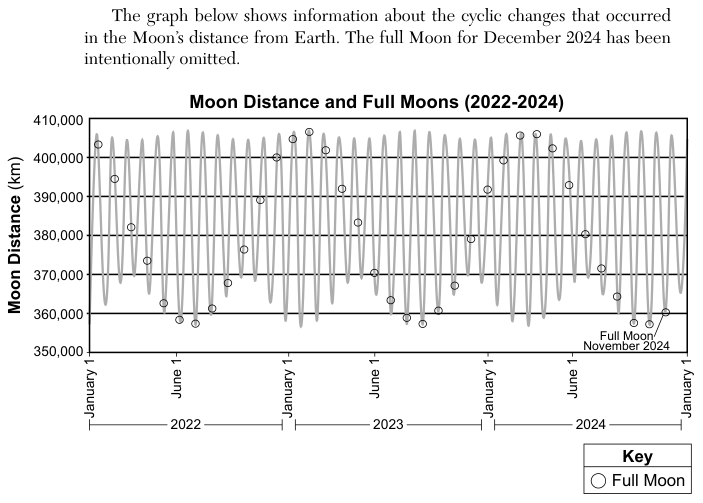
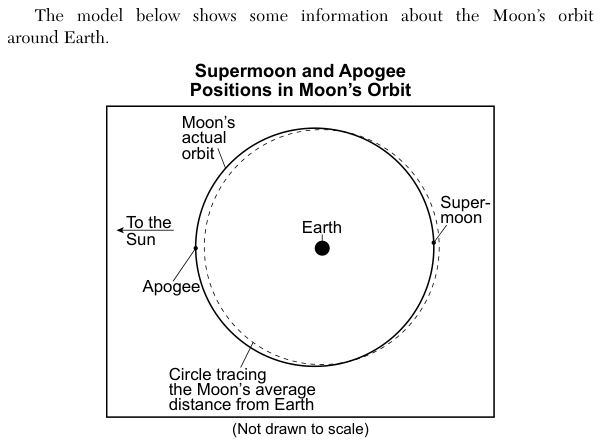
A model titled Supermoon and Apogee Positions in Moon's Orbit (not drawn to scale) shows Earth at the center, the Moon's actual orbit as a solid line, and a dashed circle tracing the Moon's average distance from Earth. The apogee position is on the left, on the side marked To the Sun, where the solid orbit lies outside the dashed circle. The supermoon position is on the right, where the solid orbit lies inside the dashed circle. The passage says a full supermoon occurs when the Moon is at or very close to perigee, and perigee is when the Moon is closest to Earth.
How to think about it
Two things must be settled. First, use the model and the passage to decide where the supermoon is compared with apogee. Second, think about how the pull of gravity between two objects changes as the distance between them changes, and how that pull affects the speed of an object in orbit.
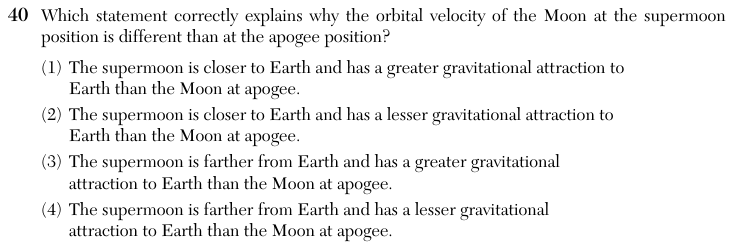
Which statement correctly explains why the orbital velocity of the Moon at the supermoon position is different than at the apogee position?
Choice 1 is right. The supermoon happens near perigee, the point in the orbit closest to Earth. The gravitational attraction between two objects gets stronger as the distance between them gets smaller, so Earth pulls harder on the Moon at the supermoon position than at apogee. This stronger pull speeds the Moon up as it moves toward perigee, so its orbital velocity is greatest there and least at apogee.
The supermoon is closer to Earth, but the pull of gravity is greater, not lesser, when objects are closer together. This choice reverses how gravity changes with distance.
The supermoon is near perigee, the closest point of the orbit, not a point farther away than apogee. The model shows apogee as the point where the orbit lies outside the average-distance circle.
Farther from Earth with a weaker pull describes the Moon at apogee itself, not at the supermoon position. This choice may come from mixing up the two positions in the model.