Earth and Space Sciences Regents, August 2026, question 39
Tap an image to open it full size.
What the figure shows
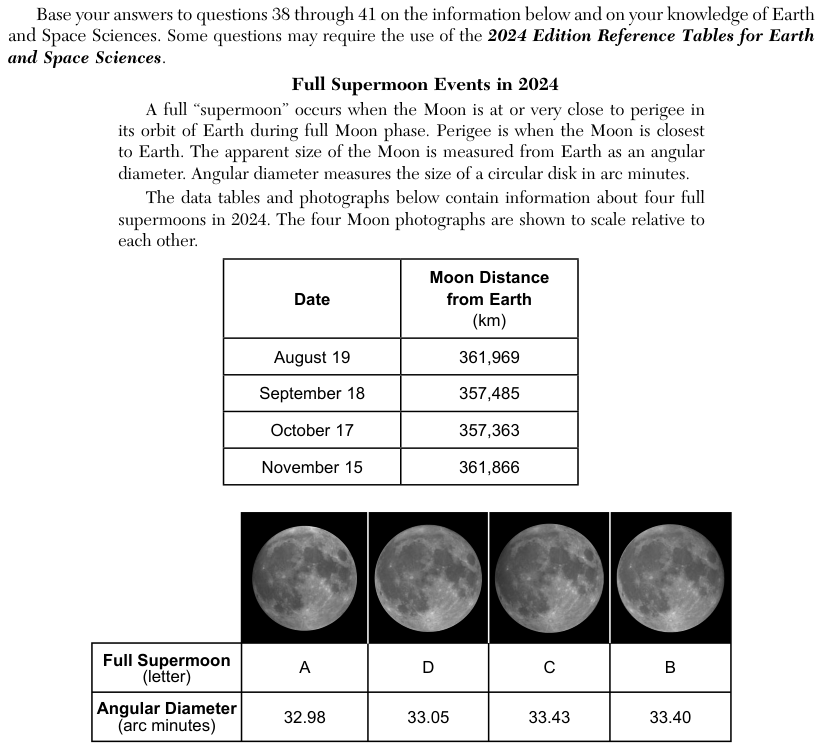
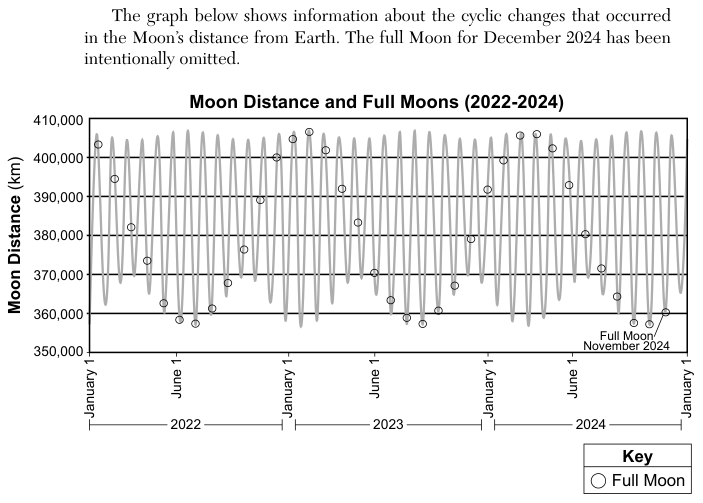
A line graph titled Moon Distance and Full Moons (2022-2024) plots the Moon's distance from Earth in kilometers (km), from 350,000 to 410,000 km, against time from January 1, 2022 to January 1, 2025. A grey curve rises and falls about once a month between roughly 356,000 and 407,000 km. Open circles mark the distance at each full Moon. The last circle is labelled Full Moon November 2024, at about 360,000 km; the December 2024 full Moon has been left off. A data table gives full supermoon distances in 2024: August 19, 361,969 km; September 18, 357,485 km; October 17, 357,363 km; November 15, 361,866 km.
How to think about it
Follow the full Moon circles through the second half of 2024 and see which way they are moving from month to month. The circles do not jump about at random: they form a slow wave of their own. Look earlier in the graph for a run of full Moons near the bottom of the graph and see where the next full Moon after that run fell.
What is the most likely approximate Moon distance that occurred during the full Moon on December 15, 2024, based on information from the graph?
Choice 4 is right. The full Moon distances in 2024 reach their lowest values in September and October (about 357,000 km) and start to rise again in November (about 361,900 km). The same pattern appears earlier on the graph: after a run of full Moons near 357,000 km, the next one is a few thousand kilometers farther away, at about 367,000 km. So the December 15, 2024 full Moon was most likely at about 367,000 km.
392,000 km is close to the tops of the grey curve, where the Moon is near its farthest point (apogee). It may come from reading the curve's high points instead of following the trend of the full Moon circles, which change only a few thousand kilometers from one month to the next.
On the graph, after a full Moon near 361,000 km, the next full Moons fall near 367,000 km, then about 376,000 to 379,000 km, then about 389,000 to 392,000 km. So 388,000 km fits a full Moon about three months after November, not one month after it.
373,000 km is in the right direction, since the full Moon distance is rising, but it is too large a step for one month. On the graph, the first full Moon after a run near 357,000 km sits closer to 367,000 km, and 373,000 km fits a full Moon one or two months later.