Earth and Space Sciences Regents, August 2026, question 9
Tap an image to open it full size.
What the figure shows
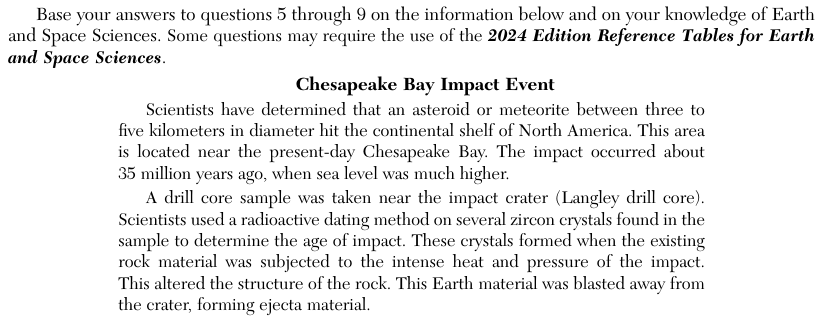
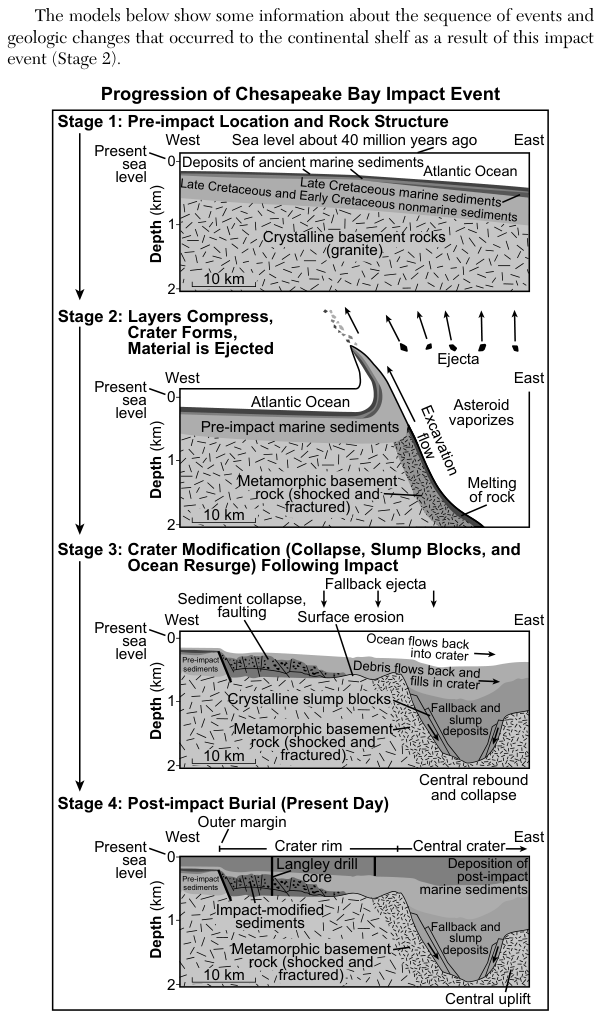
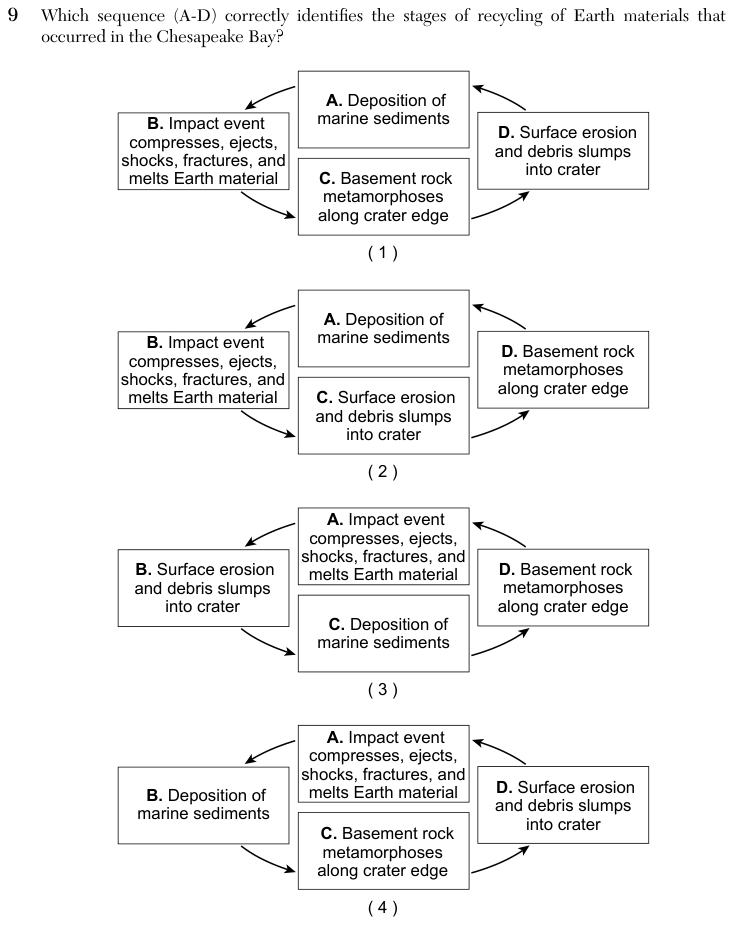
Each of the four choices is a diagram of four boxes, labeled A to D, joined in a loop by arrows that run from A to B, B to C, C to D and D back to A. Diagram (1): A deposition of marine sediments; B impact event compresses, ejects, shocks, fractures, and melts Earth material; C basement rock metamorphoses along crater edge; D surface erosion and debris slumps into crater. Diagram (2): A deposition of marine sediments; B impact event; C surface erosion and debris slumps into crater; D basement rock metamorphoses along crater edge. Diagram (3): A impact event; B surface erosion and debris slumps into crater; C deposition of marine sediments; D basement rock metamorphoses along crater edge. Diagram (4): A impact event; B deposition of marine sediments; C basement rock metamorphoses along crater edge; D surface erosion and debris slumps into crater. The context is the four-stage model Progression of Chesapeake Bay Impact Event, from Stage 1 (pre-impact sediments over granite) to Stage 4 (present-day burial by post-impact marine sediments).
How to think about it
Use the four stages of the Progression model to find when each process happens: before the impact, during it, right after it, or later. Then follow the arrows in each loop, starting from any box, and check that every step comes in the same order as the stages.
Which sequence (A-D) correctly identifies the stages of recycling of Earth materials that occurred in the Chesapeake Bay? A. Deposition of marine sediments D. Surface erosion and debris slumps into crater C. Basement rock metamorphoses along crater edge B. Impact event compresses, ejects, shocks, fractures, and melts Earth material