Earth and Space Sciences Regents, June 2026, question 17
Tap an image to open it full size.
What the figure shows
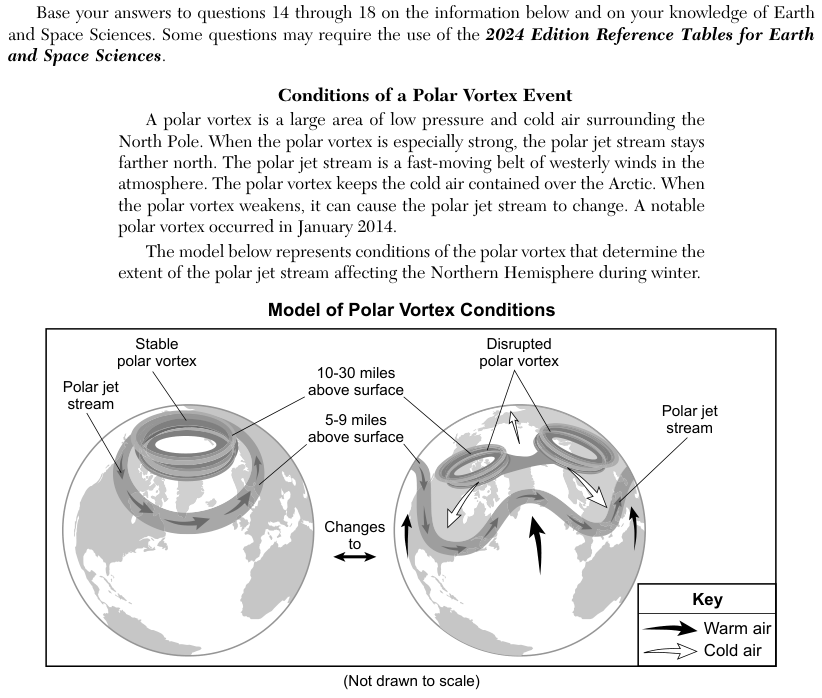
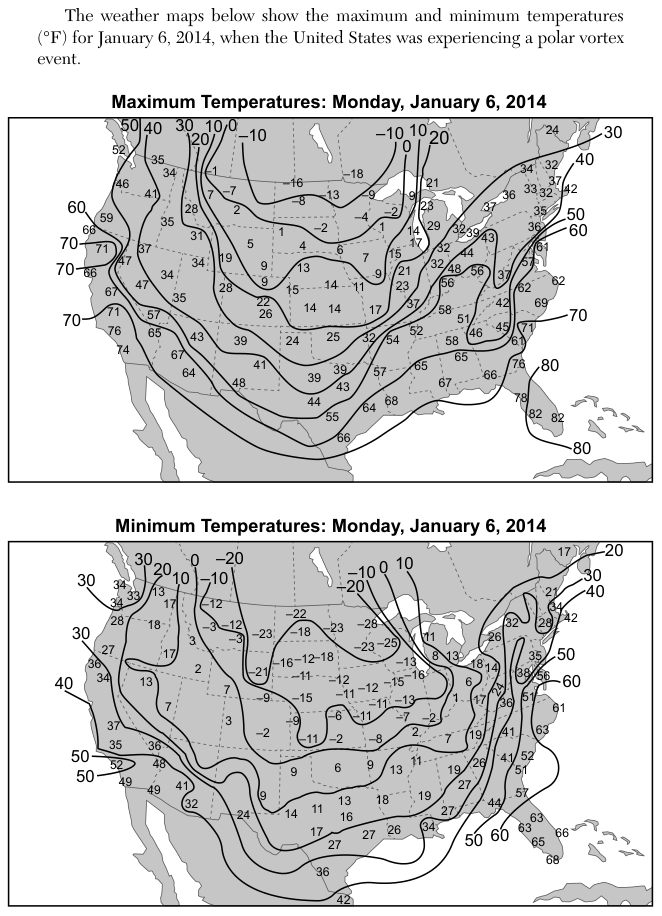
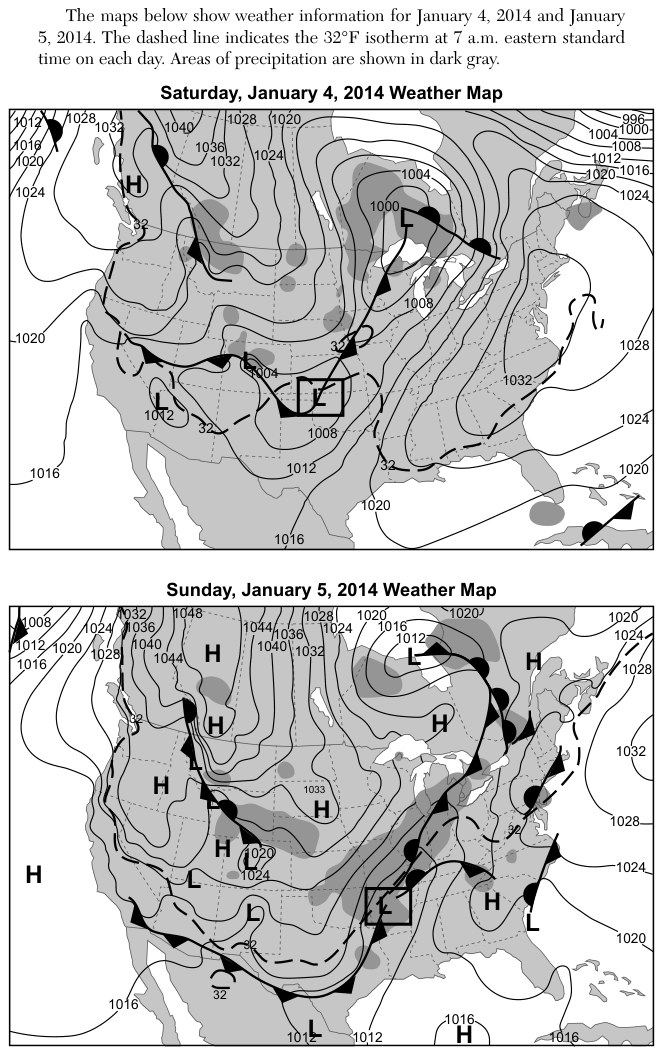
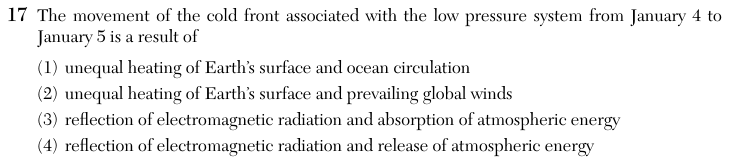
The passage describes the polar vortex, an area of low pressure and cold air around the North Pole, and the polar jet stream, a fast-moving belt of westerly winds; a model shows a stable and a disrupted polar vortex with warm and cold air arrows. Two weather maps for January 4 and January 5, 2014 show a low pressure system with a cold front over the central and southern United States. The question gives four pairs of causes for the movement of the cold front.
How to think about it
Ask what makes air, and the fronts between air masses, move across the middle latitudes of North America, and where the energy for that motion comes from. The Model of Generalized Planetary Wind Belts in the Troposphere on page 19 shows how air circulates over Earth.
The movement of the cold front associated with the low pressure system from January 4 to January 5 is a result of
Choice 2 is right. The Sun heats Earth's surface unequally, more near the equator than near the poles. This sets up pressure differences, and together with Earth's rotation it produces the planetary wind belts. Over the United States the prevailing westerlies, with the polar jet stream above them, push lows and their cold fronts from west to east, as the two maps show.
Unequal heating is part of the cause, but ocean circulation moves water, not air masses over land. Surface ocean currents are themselves driven by the winds. This choice may come from mixing up the two systems that the winds drive.
Reflection of electromagnetic radiation sends energy back to space and does not push air. The energy that drives weather comes from the radiation that is absorbed unequally, not from the part that is reflected. This choice may come from mixing up reflection with uneven heating.
Reflected radiation does not drive winds or fronts. Energy released in the atmosphere, for example when water vapor condenses, can strengthen storms, but it does not set the direction a front moves. This choice may come from mixing up storm growth with storm movement.