Earth and Space Sciences Regents, June 2026, question 7
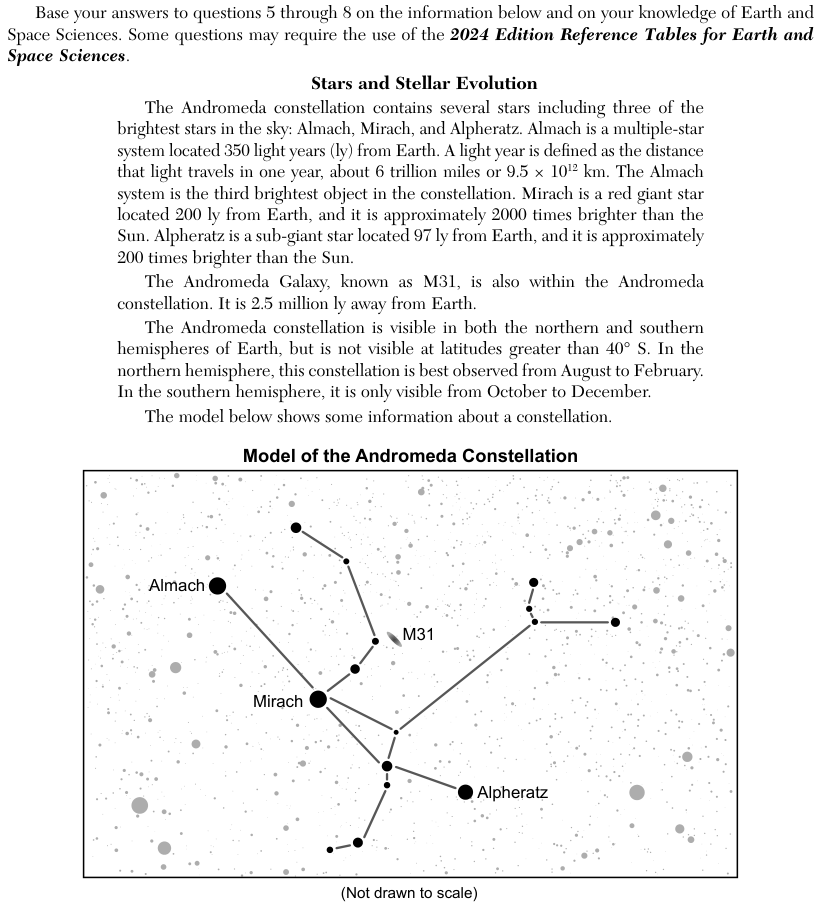
Tap an image to open it full size.
What the figure shows
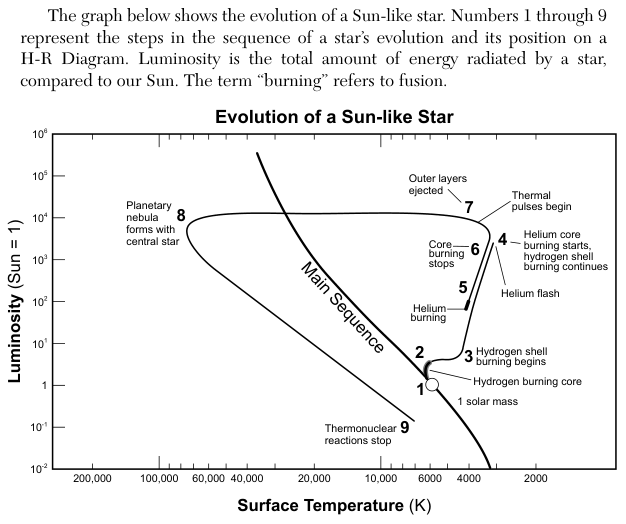
The graph Evolution of a Sun-like Star plots luminosity (Sun = 1), from 0.01 to 1,000,000, against surface temperature in kelvins (K), from 200,000 K on the left to 2000 K on the right, with the main sequence drawn as a curve. The passage says luminosity is the total amount of energy radiated by a star, compared to our Sun; this is the energy a star radiates each second. It also says "burning" refers to fusion. A path for a star of 1 solar mass is marked with steps 1 to 9: 1, hydrogen burning core; 3, hydrogen shell burning begins; 4, helium core burning starts, hydrogen shell burning continues, and helium flash; 5, helium burning; 6, core burning stops; 7, thermal pulses begin and outer layers ejected; 8, planetary nebula forms with central star; 9, thermonuclear reactions stop. Step 2 sits on the main sequence a little above step 1 with no label.
How to think about it
The claim is about where a star's energy comes from, and the graph says that burning means fusion. Check each statement word for word against the labels printed at the step numbers it names. Then ask whether a statement that matches the graph says anything about the source of the star's energy.
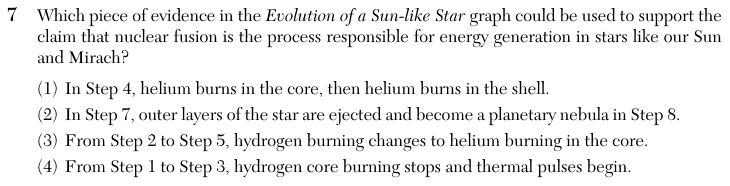
Which piece of evidence in the Evolution of a Sun-like Star graph could be used to support the claim that nuclear fusion is the process responsible for energy generation in stars like our Sun and Mirach?