Earth and Space Sciences Regents, June 2026, question 5
Tap an image to open it full size.
What the figure shows
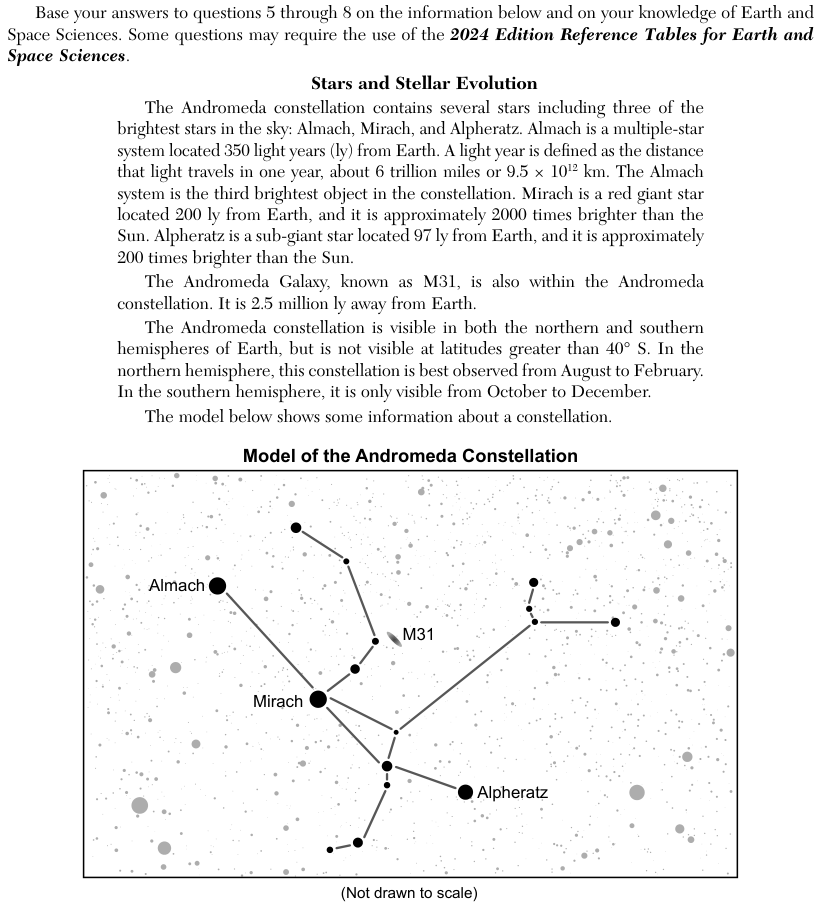
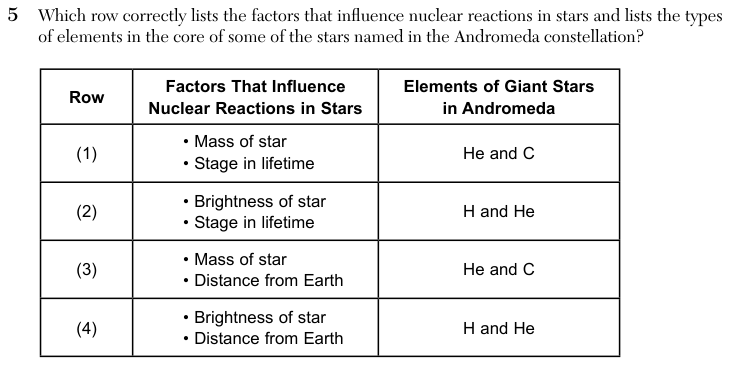
The passage describes the Andromeda constellation. Almach is a multiple-star system 350 light-years (ly) from Earth. Mirach is a red giant star 200 ly from Earth, about 2000 times brighter than the Sun. Alpheratz is a sub-giant star 97 ly from Earth, about 200 times brighter than the Sun. A model shows the stars of the constellation joined by lines, with Almach, Mirach, Alpheratz and the Andromeda Galaxy (M31) labelled. The answer table has four rows. Row 1: mass of star and stage in lifetime; He and C. Row 2: brightness of star and stage in lifetime; H and He. Row 3: mass of star and distance from Earth; He and C. Row 4: brightness of star and distance from Earth; H and He. Here H is hydrogen, He is helium and C is carbon.
How to think about it
Answer the two columns separately. For the first column, check each pair of properties against the Life Cycles of Stars Model and the passage. For the second column, find which stars the passage calls giants, then use the Life Cycles of Stars Model and the Generalized Nucleosynthesis in a Massive Star diagram to see which fusion step follows hydrogen fusion.
Which row correctly lists the factors that influence nuclear reactions in stars and lists the types of elements in the core of some of the stars named in the Andromeda constellation? Row Factors That Influence Nuclear Reactions in Stars Elements of Giant Stars in Andromeda
Reference table: Life Cycles of Stars Model (2024 edition, page 5)