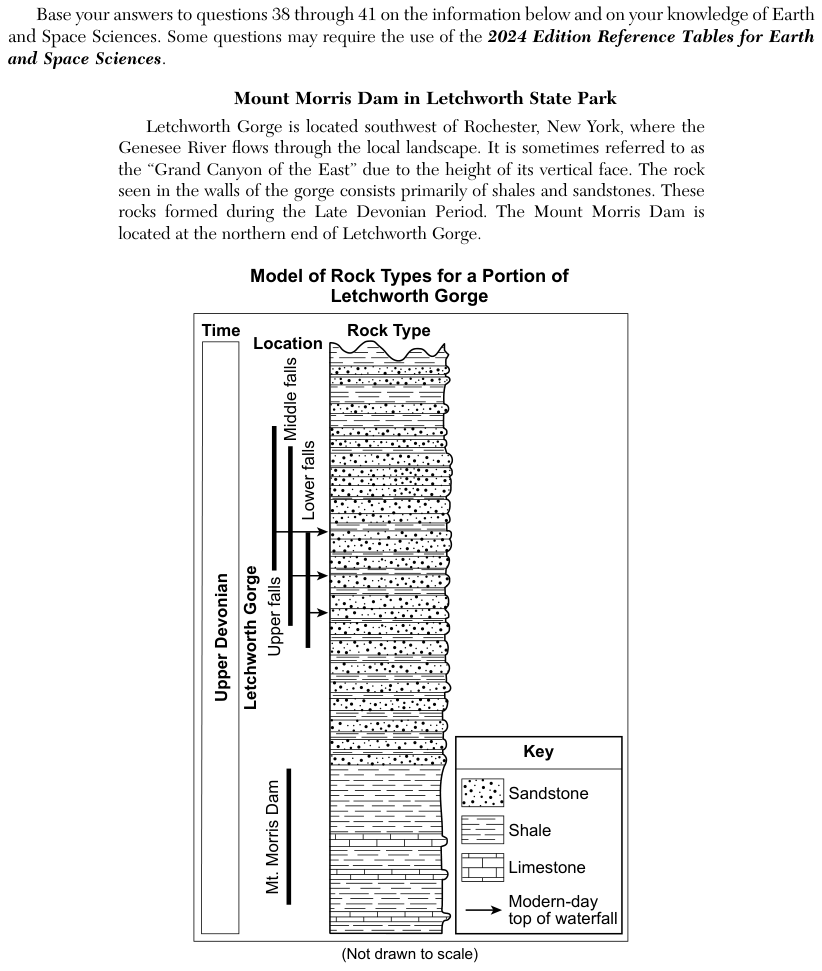
Earth and Space Sciences Regents, January 2026, question 39
Tap an image to open it full size.
What the figure shows
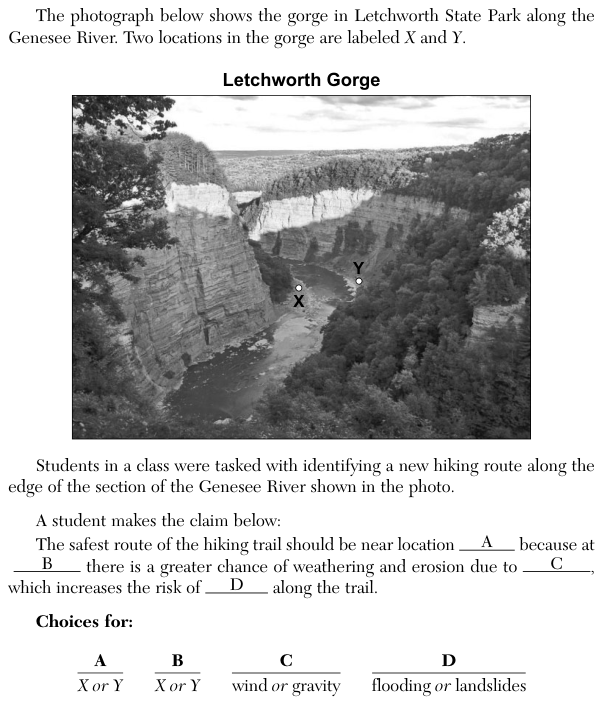
A black-and-white photograph titled Letchworth Gorge shows the Genesee River at the bottom of a deep gorge. On the left, a tall, steep cliff of layered rock rises from the river, and location X is at the water's edge where a patch of trees grows at the foot of that cliff. On the right, location Y is at the water's edge at the foot of a steep slope of bare, broken rock with no trees on it; the slope below and to the right of Y is covered by forest. The claim reads: "The safest route of the hiking trail should be near location A because at B there is a greater chance of weathering and erosion due to C, which increases the risk of D along the trail." A and B are each X or Y, C is wind or gravity, and D is flooding or landslides.
How to think about it
Look closely at the ground and the slope directly above each location in the photograph. Then ask which force moves loose rock down a steep slope, and which hazard that movement causes. The four blanks must fit together: the location named in B is the one the trail should avoid.
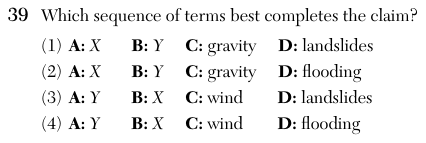
Which sequence of terms best completes the claim?
Choice 1 is right. Location Y sits at the foot of a steep slope of bare, broken rock with no plants to hold it. Gravity pulls weathered rock and soil down such a slope, so the risk of landslides and falling rock is greater at Y. The trail is safer near X, where trees cover the ground at the foot of the cliff.
This choice has the right locations and the right force, but flooding is a risk from rising river water, not from weathering and erosion of a slope. Loose rock moved by gravity on a steep slope causes landslides.
This choice reverses the two locations and names the wrong force. Wind moves fine sand and dust, but it does not move large amounts of broken rock down a gorge wall; gravity does. Y, below the bare slope, is the less safe place.
This choice reverses the two locations, names wind instead of gravity, and names flooding instead of landslides. It may come from thinking of the river as the main danger, but the claim is about weathering and erosion of the slope above the trail.