Earth and Space Sciences Regents, January 2026, question 40
Tap an image to open it full size.
What the figure shows
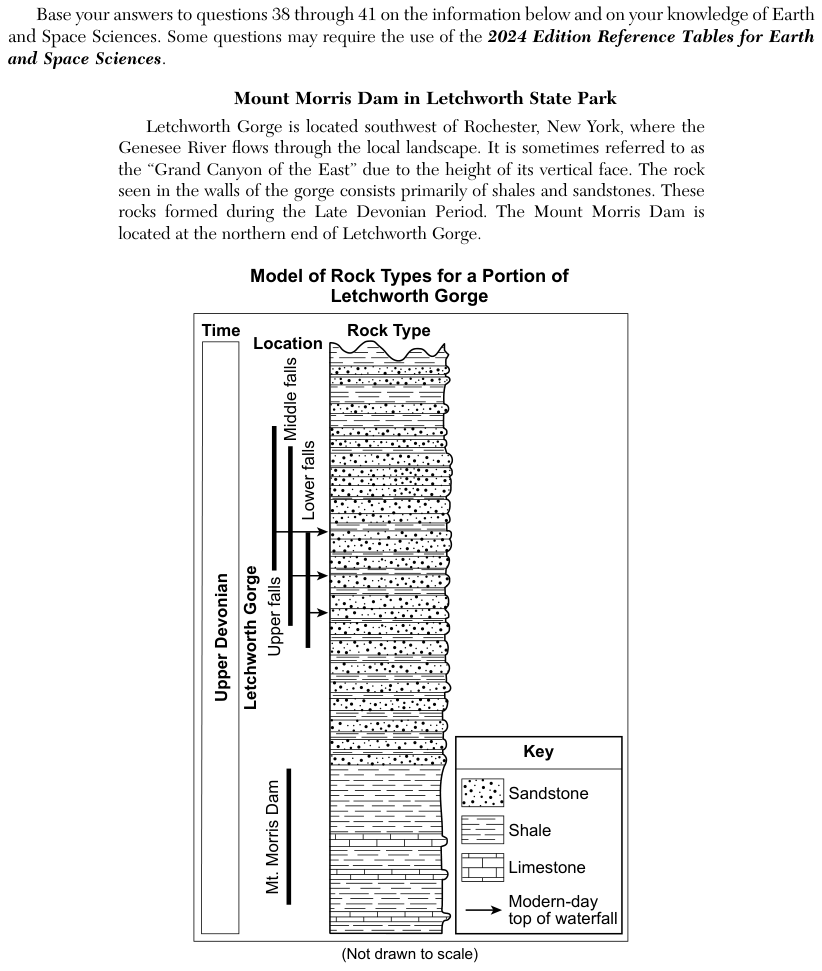
The model Model of Rock Types for a Portion of Letchworth Gorge is a column of rock layers from the Upper Devonian. From the top down it shows many thin layers of sandstone and shale, then mostly shale with some thin layers of limestone near the bottom. The layers are flat and stacked one above the other. Arrows mark the modern-day tops of the Upper, Middle and Lower falls, and a bar marks the level of the Mount Morris Dam near the bottom. The passage says the rocks in the gorge walls are mainly shales and sandstones that formed during the Late Devonian Period.
How to think about it
First decide which of the three rock groups (igneous, sedimentary or metamorphic) shale, sandstone and limestone belong to. Then open the Rock Cycle Infographic and follow the path that forms that rock group. The question asks for constructive processes, the ones that build rock, not the ones that break it down.
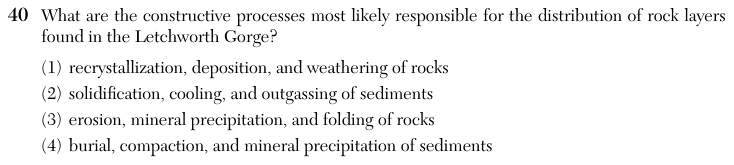
What are the constructive processes most likely responsible for the distribution of rock layers found in the Letchworth Gorge?
Choice 4 is right. Shale, sandstone and limestone are sedimentary rocks. Sediments were laid down in layers, then buried under more sediment. The weight of the layers above compacted them, and minerals that came out of solution in the water between the grains cemented them together. The Rock Cycle Infographic shows this path as deposition, burial, and compaction and cementation (lithification).
Recrystallization forms metamorphic rocks, and weathering breaks rocks down instead of building them. The gorge layers are sedimentary, not metamorphic.
Solidification and cooling form igneous rocks from magma or lava, and outgassing releases gases from volcanoes. These processes do not turn sediments into shale or sandstone.
Erosion removes and carries rock away, so it is a destructive process. Folding bends rock layers, but the layers in the model are flat. This choice may come from mixing rock-forming processes with processes that change rock after it forms.