Earth and Space Sciences Regents, January 2026, question 36
Tap an image to open it full size.
What the figure shows
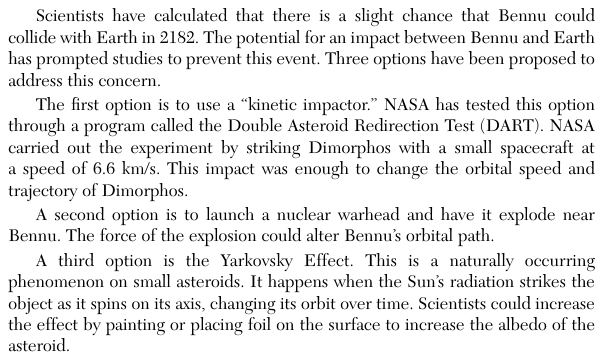
The passage describes the Double Asteroid Redirection Test (DART), in which the National Aeronautics and Space Administration (NASA) struck the small asteroid Dimorphos with a spacecraft at a speed of 6.6 kilometers per second (km/s). The impact changed Dimorphos' orbital speed and path. The question asks why the spacecraft's speed changed before it hit Dimorphos.
How to think about it
Gravity always pulls an object toward the body that attracts it. For each body named in the choices, think about where DART was in relation to that body in the last part of the flight, before impact. Then ask whether its pull would speed DART up or slow it down at that moment.
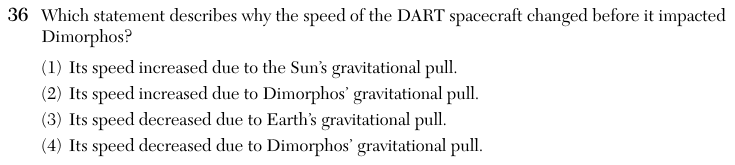
Which statement describes why the speed of the DART spacecraft changed before it impacted Dimorphos?
Choice 2 is right. In the last part of its trip, DART was moving toward Dimorphos, and Dimorphos' gravity pulled the spacecraft toward it, in the same direction it was moving. A pull in the direction of motion makes an object speed up. Dimorphos is small, so its pull is weak and the increase in speed was very small.
The Sun's gravity acts on DART and on Dimorphos during the whole trip, pulling both toward the Sun. In the question's simplified model, the change in speed it asks about comes from the extra pull toward Dimorphos as DART closed in. This choice may come from thinking of the Sun as the only body whose gravity matters.
Earth's gravity did slow the spacecraft after launch, as it climbed away from Earth. But in the last part of the flight, before impact, DART was millions of kilometers from Earth and close to Dimorphos, so Earth's pull does not explain the change at that time.
Gravity pulls an object toward the attracting body. DART was moving toward Dimorphos, so the pull was in the direction of motion and would speed it up, not slow it down.