Earth and Space Sciences Regents, January 2026, question 34
Tap an image to open it full size.
What the figure shows
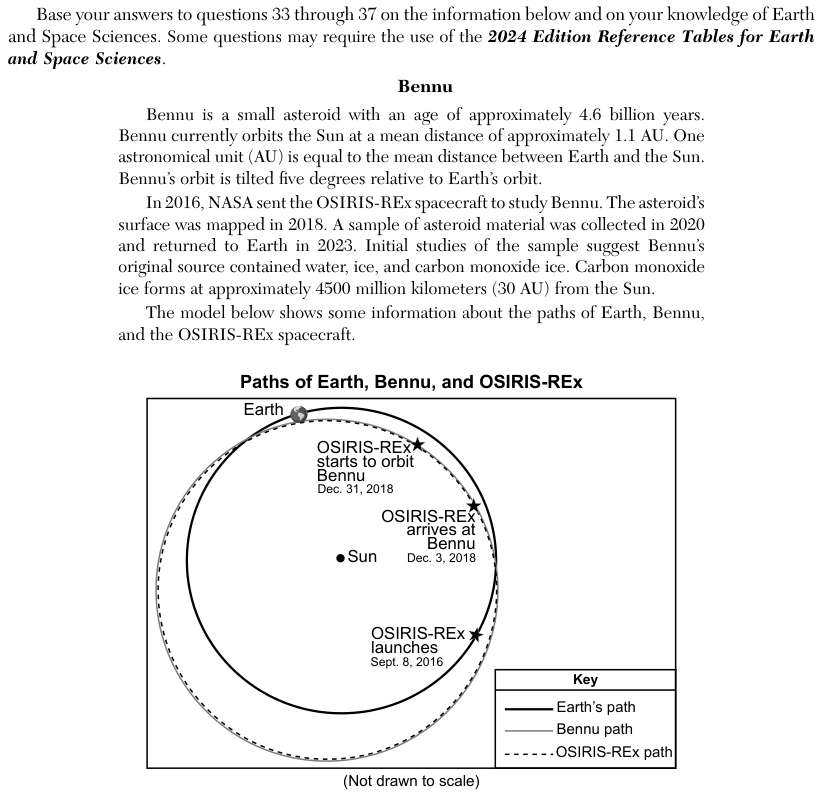
The passage says Bennu is a small asteroid about 4.6 billion years old that now orbits the Sun at a mean distance of about 1.1 astronomical units (AU). Studies of its sample suggest its original source contained water ice and carbon monoxide ice. Carbon monoxide ice forms at about 4500 million kilometers (30 AU) from the Sun.
How to think about it
Two clues in the passage matter: where carbon monoxide ice forms, and how old Bennu is. Use the Solar System Objects Data Table to compare 4500 million km with the distances of the planets, and the Geologic History of New York State page to match 4.6 billion years with an event. Then compare that starting place with Bennu's present distance.
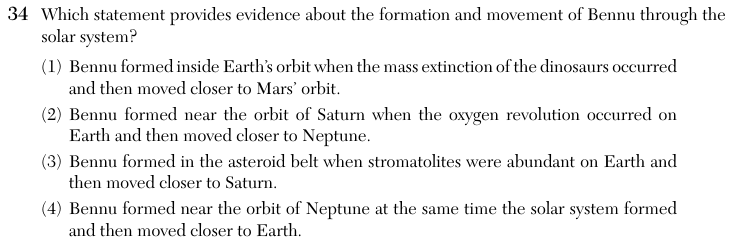
Which statement provides evidence about the formation and movement of Bennu through the solar system?
Choice 4 is right. Carbon monoxide ice forms about 4500 million km from the Sun, and the Solar System Objects Data Table puts Neptune at 4515.0 million km, so Bennu's source formed near Neptune's orbit. Its age of 4.6 billion years matches the estimated time of origin of Earth and the solar system on the geologic history page. Bennu now orbits at about 1.1 AU, so it has moved inward, close to Earth.
The mass extinction of the dinosaurs was about 66 million years ago, much later than Bennu's age of 4.6 billion years. Inside Earth's orbit is also far too warm for carbon monoxide ice to form.
Saturn is about 1432 million km from the Sun, much closer than the 4500 million km where carbon monoxide ice forms. The Oxygen Revolution happened 2.4 to 2.1 billion years ago, not 4.6 billion years ago. Bennu also now orbits near Earth, not near Neptune.
The asteroid belt lies between Mars and Jupiter, far inside the 4500 million km where carbon monoxide ice forms. Stromatolites appear about 3.5 billion years ago, well after 4.6 billion years ago, and Bennu now orbits near Earth, not near Saturn.