Earth and Space Sciences Regents, January 2026, question 26
Tap an image to open it full size.
What the figure shows
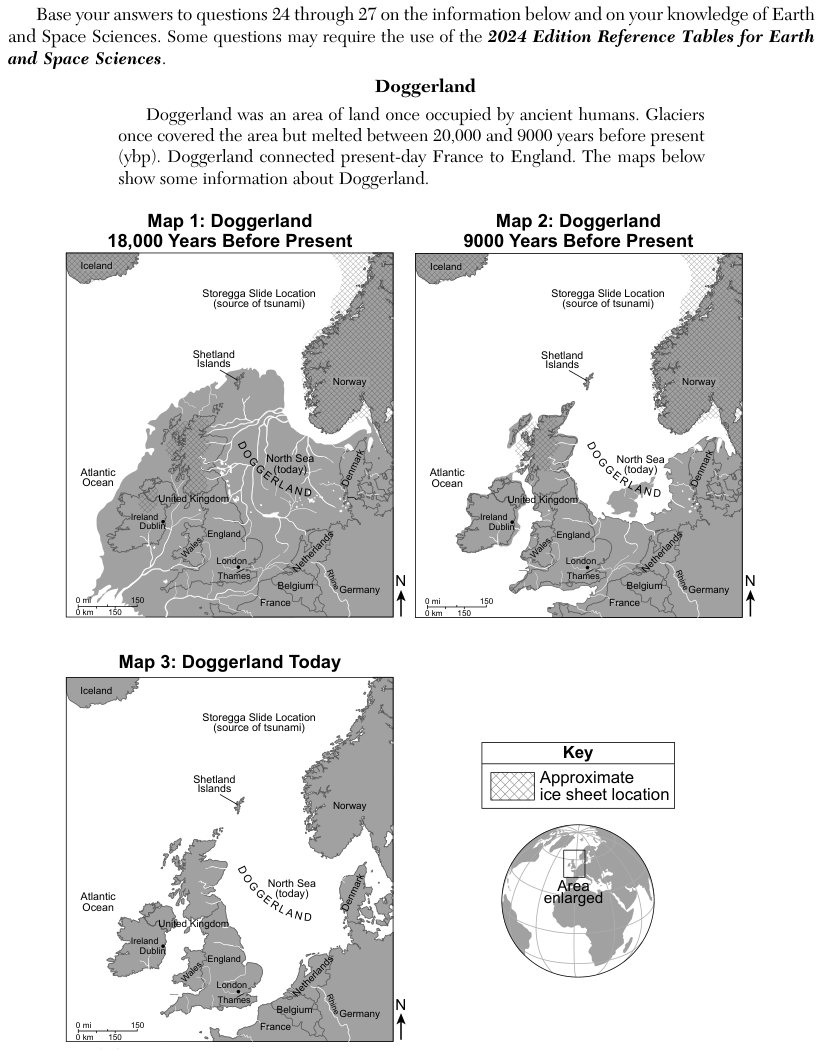
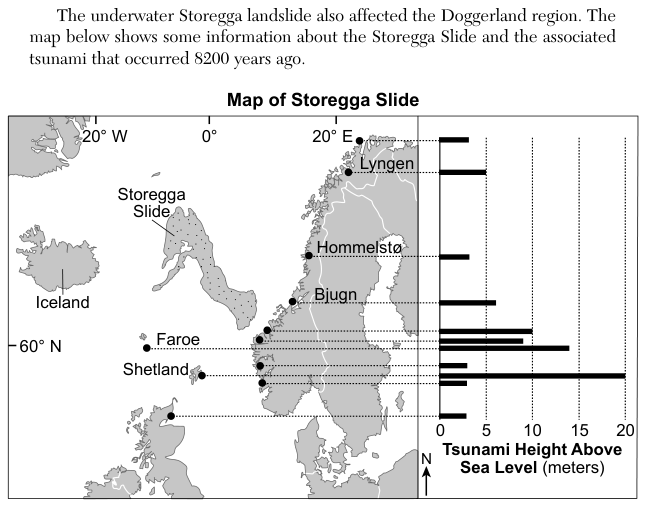
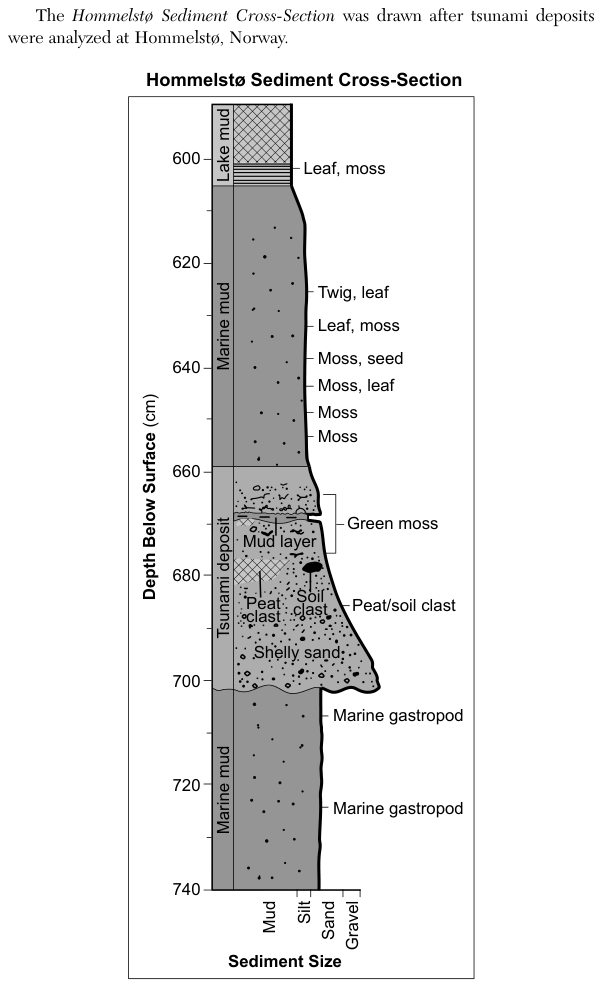
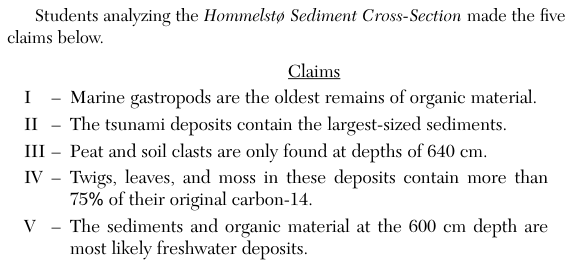
The Hommelstø Sediment Cross-Section shows depth below surface from about 590 to 740 centimeters (cm), with sediment size (mud, silt, sand, gravel) along the bottom. From the top: lake mud with leaf and moss near 600 cm; marine mud from about 605 to 659 cm with twig, leaf, moss and seed; a tsunami deposit from about 659 to 702 cm with green moss, a mud layer, peat and soil clasts near 680 to 690 cm, and shelly sand, its width reaching past sand toward gravel; and marine mud from about 702 to 740 cm with marine gastropods. Five claims are listed: I, marine gastropods are the oldest remains of organic material; II, the tsunami deposits contain the largest-sized sediments; III, peat and soil clasts are only found at depths of 640 cm; IV, twigs, leaves and moss in these deposits contain more than 75% of their original carbon-14; V, the sediments and organic material at the 600 cm depth are most likely freshwater deposits. An earlier passage dates the Storegga tsunami to 8200 years ago.
How to think about it
Test each claim on its own. Use the depth scale and the order of the layers for claims about age and position, and the sediment size scale for claims about grain size. For carbon-14, open the radioactive dating table, find the half-life, and work out how much carbon-14 is left after the time since the tsunami.
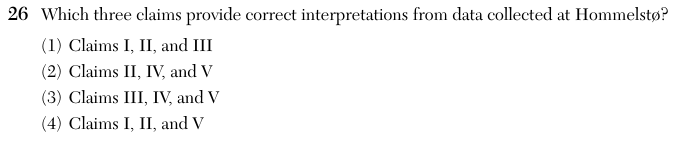
Which three claims provide correct interpretations from data collected at Hommelstø?
Choice 4 is right. Claim I is correct because the marine gastropods are in the deepest layer, and lower layers are older. Claim II is correct because the tsunami deposit reaches the sand and gravel sizes, while the other layers are mud. Claim V is correct because the 600 cm layer is lake mud with leaves and moss, which formed in fresh water.
Claims I and II are correct, but Claim III is not. The peat and soil clasts sit near 680 to 690 cm, inside the tsunami deposit; the 640 cm depth is in the marine mud. This choice may come from misreading the depth scale.
Claims II and V are correct, but Claim IV is not. Carbon-14 has a half-life of 5730 years, so more than 75% remains only in material younger than about 2400 years. The green moss in the tsunami deposit dates from the tsunami, about 8200 years ago, so it keeps only about 37% of its carbon-14. The twigs, leaves and moss in the layers above would need their own age evidence, and the figure gives none that shows they are younger than about 2400 years.
Claim V is correct, but Claims III and IV are not. The peat and soil clasts lie near 680 to 690 cm, not at 640 cm. The moss in the tsunami deposit is about 8200 years old and keeps only about 37% of its carbon-14, and the figure gives no age for the plant remains above it.