Earth and Space Sciences Regents, January 2026, question 7
Tap an image to open it full size.
What the figure shows
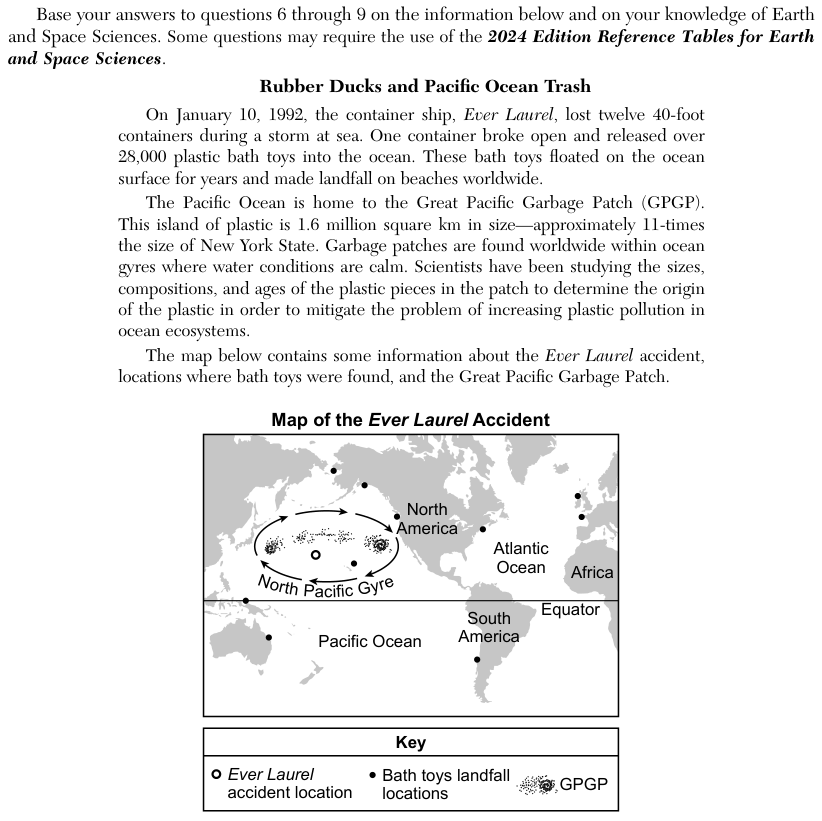
The passage says that in 1992 a container ship, the Ever Laurel, lost containers in a storm at sea, and over 28,000 plastic bath toys floated on the ocean surface for years and came ashore on beaches worldwide. The map marks the accident location in the North Pacific Ocean, the North Pacific Gyre as a loop of arrows, the Great Pacific Garbage Patch (GPGP) inside the gyre, and landfall dots on coasts around the Pacific and the Atlantic, including Alaska, North America, South America, Australia and Europe.
How to think about it
Read the passage and the map to see how far the toys travelled and where they came ashore. Then compare each proposed factor with the passage and with the models on page 19 of the reference tables. Ask whether each factor could carry the toys over the distances shown on the map.
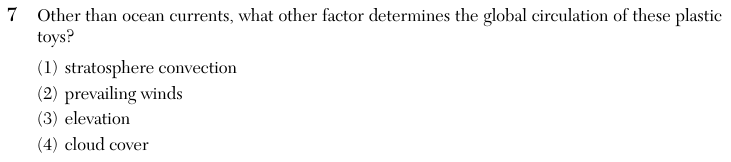
Other than ocean currents, what other factor determines the global circulation of these plastic toys?
Choice 2 is right. Prevailing winds blow across the ocean surface in steady global belts, such as the westerlies and the trade winds on page 19. They push directly on floating toys, and they also drive the surface ocean currents that make gyres such as the North Pacific Gyre.
The stratosphere lies above the tropopause, about 9 to 17 kilometers up in the cross section on page 19. Air movement there does not reach objects floating on the sea surface, and most convection happens in the troposphere below it.
Elevation is the height of land above sea level. The sea surface is at about the same level everywhere, so elevation does not move floating toys across the ocean.
Cloud cover changes how much sunlight reaches the surface, but clouds do not push objects across the ocean. This choice may come from linking weather in general with movement, without asking which weather factor actually pushes on the water surface.