Earth and Space Sciences Regents, January 2026, question 8
Tap an image to open it full size.
What the figure shows
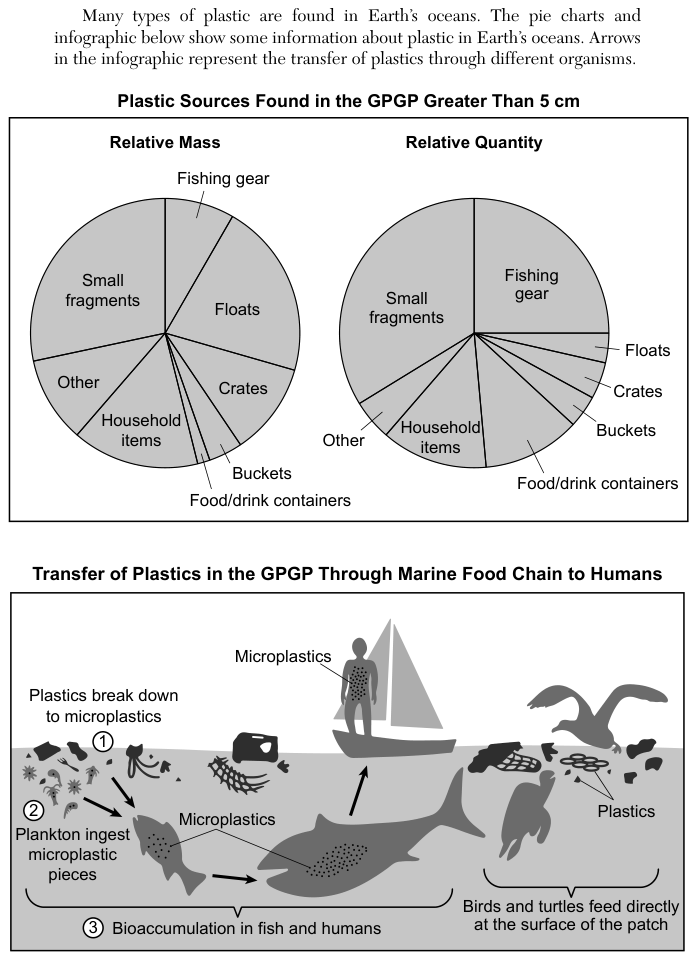
The passage says sea turtles in the Great Pacific Garbage Patch (GPGP) often feed on plastic bags and plastic sheets, because they mistake the plastic for their common prey, jellyfish. An infographic shows plastics moving through the marine food chain, with the label: birds and turtles feed directly at the surface of the patch. Two pie charts show the relative mass and relative quantity of plastic sources larger than 5 centimeters found in the GPGP.
How to think about it
Follow the food chain step by step. Ask what the turtles eat when plastic bags are present, and what they eat when the bags are removed. Then ask how that change in diet affects the turtles' health and numbers.
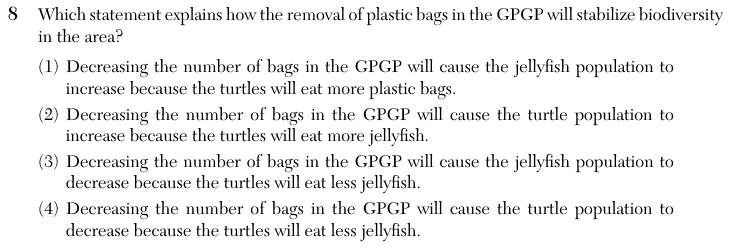
Which statement explains how the removal of plastic bags in the GPGP will stabilize biodiversity in the area?
Choice 2 is right. Turtles eat plastic bags because they mistake them for jellyfish. With fewer bags in the water, the turtles find and eat more real jellyfish and swallow less harmful plastic. Better feeding and less harm from plastic lead to a larger turtle population.
Removing bags means there are fewer bags to eat, so the turtles cannot eat more plastic bags. This choice reverses the effect of the cleanup on what the turtles eat.
With fewer bags, the turtles eat more jellyfish, not less, because fewer bags are mistaken for prey. Also, if turtles did eat fewer jellyfish, the jellyfish population would grow, not shrink, so the cause and the effect in this choice do not match.
Removing bags gives the turtles more real food and less harmful plastic, so their population would grow, not shrink. This choice may come from mixing up the bags with the turtles' actual food.