Earth and Space Sciences Regents, January 2026, question 4
Tap an image to open it full size.
What the figure shows
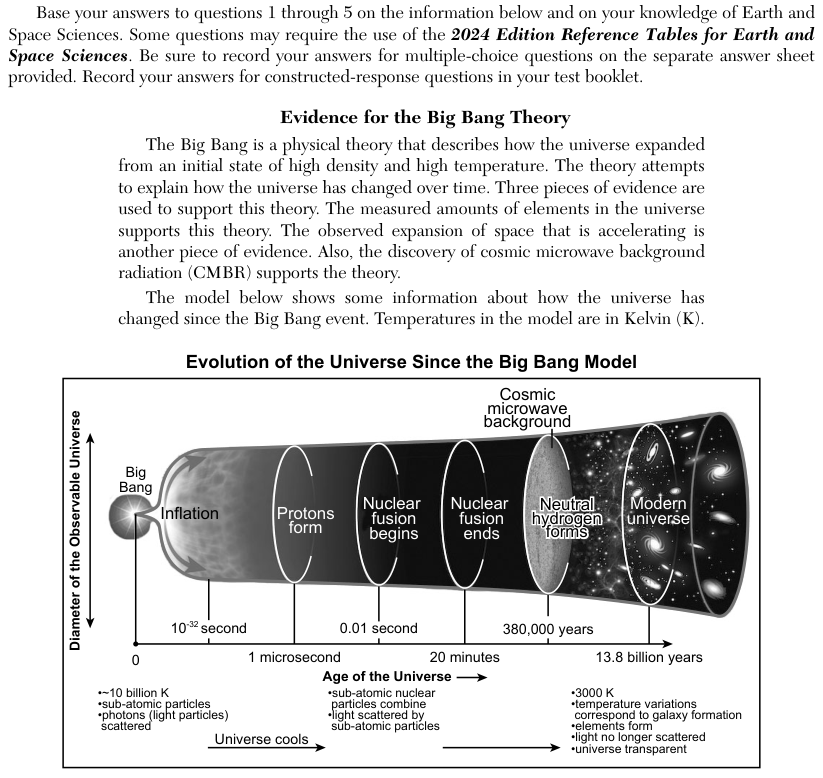
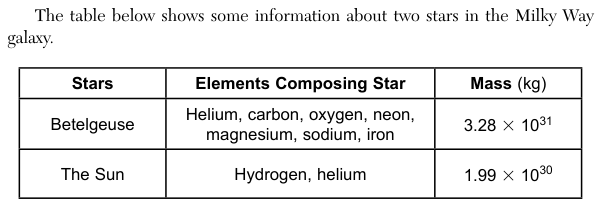
A table describes two stars in the Milky Way galaxy. Betelgeuse is made of helium, carbon, oxygen, neon, magnesium, sodium and iron, and has a mass of 3.28 x 10^31 kilograms (kg). The Sun is made of hydrogen and helium, and has a mass of 1.99 x 10^30 kg. The earlier passage and model describe the Big Bang and how elements formed.
How to think about it
First compare the two masses: work out how many times more massive one star is than the other. Then open the Life Cycles of Stars Model (page 5) to see how star mass relates to how long a star lives, and the Generalized Nucleosynthesis in a Massive Star diagram (page 2) to see which elements are made from which during fusion.
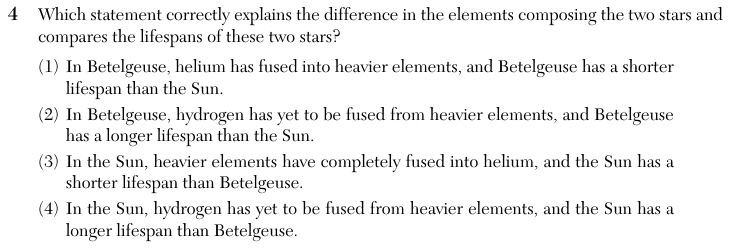
Which statement correctly explains the difference in the elements composing the two stars and compares the lifespans of these two stars?
Choice 1 is right. Fusion in stars builds heavier elements from lighter ones: hydrogen to helium, then helium to carbon, and on up to iron, as the Generalized Nucleosynthesis in a Massive Star diagram shows. Betelgeuse contains these heavier elements, so its helium has fused into heavier ones. Betelgeuse is about 16 times the mass of the Sun, and the Life Cycles of Stars Model shows that massive stars (more than 8 to 10 times the mass of the Sun) last millions of years, while Sun-like stars last billions of years.
Fusion does not make hydrogen from heavier elements; it turns light elements such as hydrogen into heavier ones. Also, a more massive star uses up its fuel faster, so Betelgeuse has a shorter lifespan than the Sun, not a longer one.
The item's table lists the Sun as hydrogen and helium. The Sun does hold small amounts of heavier elements taken in from the cloud it formed from, but the point here is the direction of fusion: the Sun is at a different stage from Betelgeuse, still fusing hydrogen into helium, and heavier elements do not fuse into helium. The Sun also lives longer than Betelgeuse, because less massive stars use their fuel more slowly.
The lifespan part is correct: the Sun lives longer than Betelgeuse. But the first part reverses the direction of fusion. Hydrogen is the starting fuel that fuses into helium; it is not made from heavier elements.