Earth and Space Sciences Regents, August 2025, question 45
Tap an image to open it full size.
What the figure shows
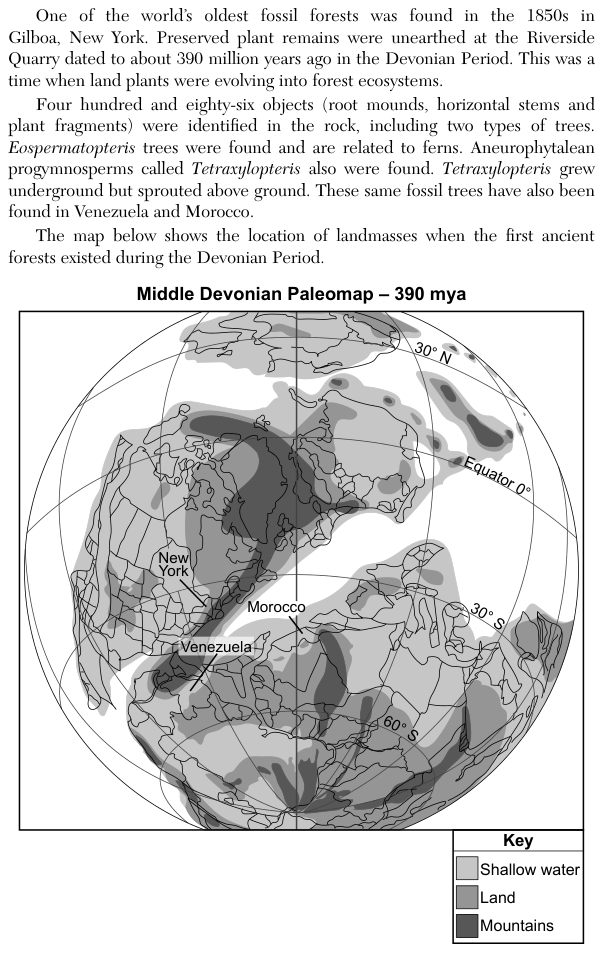
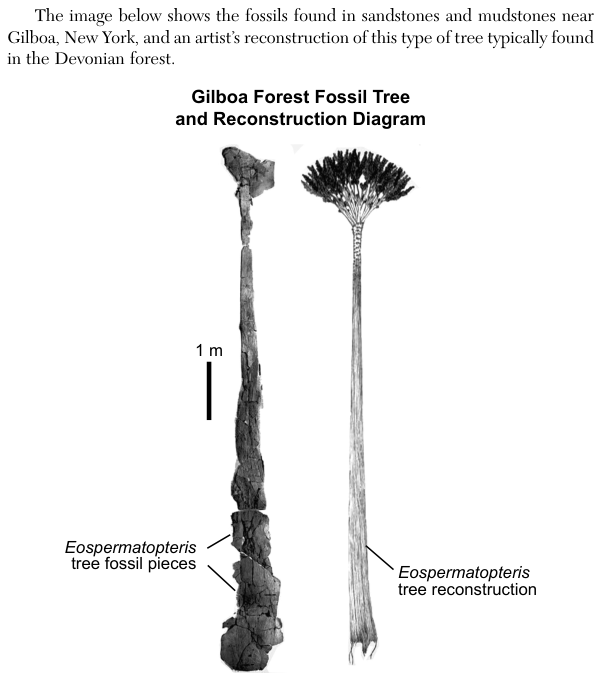
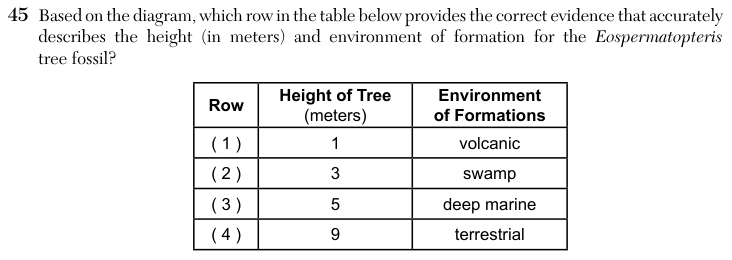
The passage says the Gilboa fossils were found in sandstones and mudstones near Gilboa, New York, in one of the world's oldest fossil forests, at a time when land plants were evolving into forest ecosystems. The Gilboa Forest Fossil Tree and Reconstruction Diagram shows the Eospermatopteris tree fossil pieces stacked end to end beside an artist's drawing of the whole tree, with a vertical scale bar marked 1 m (meter). The question's table gives four rows of tree height and environment of formation: row 1 is 1 meter, volcanic; row 2 is 3 meters, swamp; row 3 is 5 meters, deep marine; row 4 is 9 meters, terrestrial.
How to think about it
Use the scale bar as a ruler. Count how many scale bar lengths fit along the full height of the fossil pieces or the drawing. For the environment, reread the passage for where the fossils were found and in what kind of rock.
Based on the diagram, which row in the table below provides the correct evidence that accurately describes the height (in meters) and environment of formation for the Eospermatopteris tree fossil? Row Height of Tree (meters) Environment of Formations
Choice 4 is right. The 1 m scale bar fits about nine times along the full height of the fossil pieces and of the drawing, so the tree was about 9 meters tall. Trees grow on land, and the passage describes a forest ecosystem preserved in sandstones and mudstones. That makes terrestrial, meaning formed on land, the right environment.
A height of 1 meter is the length of the scale bar itself, not of the tree. Nothing in the passage points to volcanic rock; the fossils were found in sandstones and mudstones. This choice may come from reading the scale bar as the answer.
A height of 3 meters covers only about a third of the fossil pieces when measured with the scale bar. The swamp idea may come from the fern-like trees, but the 3 meter height does not match the diagram, so this row cannot be right.
A height of 5 meters reaches only about halfway up the fossil. The passage lists root mounds among the objects found in the rock, with stems and plant fragments. Roots preserved with the trees point to a forest that grew in that place, and a rooted forest does not grow on the deep sea floor. This choice may come from knowing that sandstone and mudstone often form under water.