Earth and Space Sciences Regents, August 2025, question 16
Tap an image to open it full size.
What the figure shows
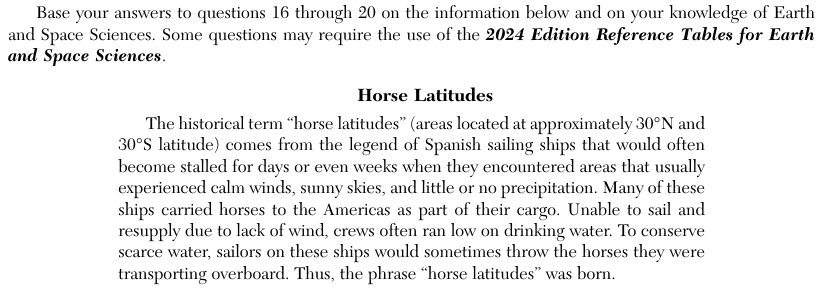
The passage, Horse Latitudes, explains that the historical term "horse latitudes" refers to areas at about 30 degrees north and 30 degrees south latitude. Sailing ships there often stalled for days or weeks in areas that usually had calm winds, sunny skies and little or no precipitation.
How to think about it
Open the Cross Section Model of Earth's Lower Atmosphere and the Model of Generalized Planetary Wind Belts in the Troposphere. Find 30 degrees north and look at the pressure label and the arrows: which way air moves up or down above that latitude, and which way it moves along the surface. Link this to the calm, dry weather the passage describes.
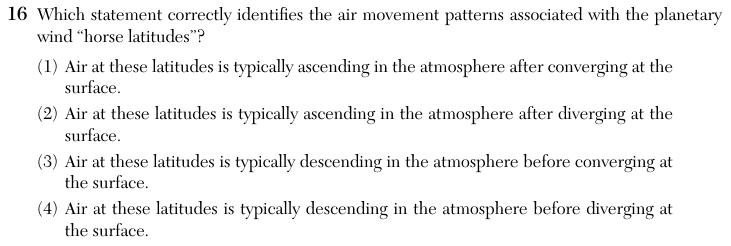
Which statement correctly identifies the air movement patterns associated with the planetary wind “horse latitudes”?
Choice 4 is right. Both models on page 19 show high pressure at 30 degrees, with arrows of air sinking from high in the troposphere. When the sinking air reaches the surface it spreads out, part toward the equator as the trade winds and part toward the poles as the westerlies. Sinking air warms and dries, which gives the clear skies and little rain the passage describes.
Rising air that came together at the surface happens near the equator, in the low pressure zone where the trade winds meet. This choice may come from mixing up the horse latitudes with the equatorial low.
Air that spreads out at the surface is fed by air coming down from above, so it cannot also be rising at that place. This choice pairs the right surface motion with the wrong vertical motion.
Air does sink at these latitudes, but it does not come together at the surface. It spreads away toward the equator and toward the poles, as the wind arrows on the model show. Air comes together at the surface in low pressure zones.