Earth and Space Sciences Regents, August 2025, question 17
Tap an image to open it full size.
What the figure shows
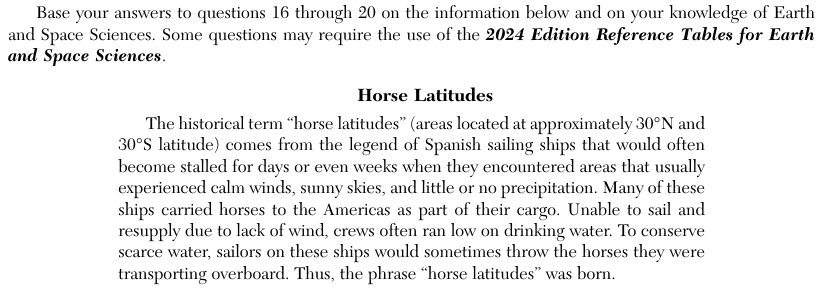
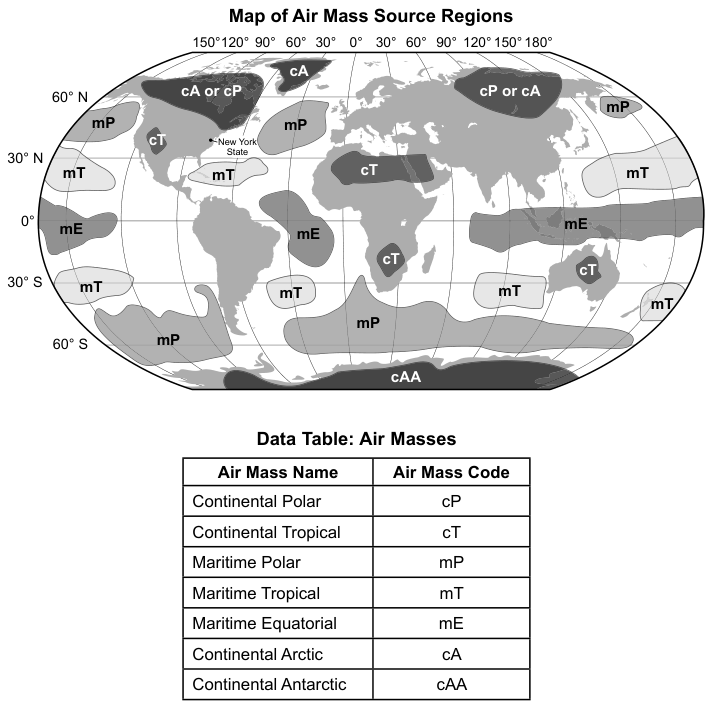
The passage says the horse latitudes are areas at about 30 degrees north and 30 degrees south latitude. A Map of Air Mass Source Regions shows where air masses form, with a continental tropical (cT) region in the southwestern United States near 30 degrees north, and others in northern Africa, southern Africa and Australia. A data table lists the air mass names and codes: continental polar (cP), continental tropical (cT), maritime polar (mP), maritime tropical (mT), maritime equatorial (mE), continental arctic (cA) and continental antarctic (cAA).
How to think about it
Open the Model of Generalized Planetary Wind Belts in the Troposphere. Find the wind belt that lies between 30 degrees north and 60 degrees north, and look at the direction of its arrows. Remember that a wind is named for the direction it comes from.
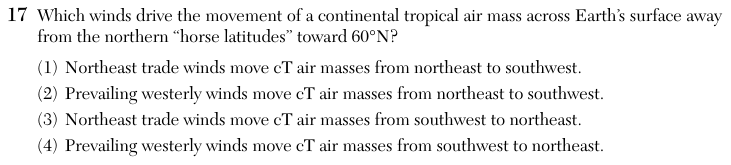
Which winds drive the movement of a continental tropical air mass across Earth’s surface away from the northern “horse latitudes” toward 60°N?
Choice 4 is right. Between 30 degrees north and 60 degrees north the planetary winds are the prevailing westerlies. They blow from the southwest toward the northeast, so they carry a continental tropical (cT) air mass from its source region near 30 degrees north toward higher latitudes. This is why weather in the United States usually moves from the southwest or west toward the northeast.
The northeast trade winds blow between 30 degrees north and the equator. They move air toward the equator, away from 60 degrees north. This choice may come from looking at the wind belt on the wrong side of the horse latitudes.
The prevailing westerlies are the right belt, but they do not blow from the northeast. A northeast to southwest motion would carry air toward the equator. This choice may come from mixing up the direction a wind comes from with the direction it goes.
The northeast trade winds blow from the northeast, not from the southwest, and they lie south of 30 degrees north. This choice pairs the wrong wind belt with the direction of the westerlies.