Earth and Space Sciences Regents, August 2025, question 13
Tap an image to open it full size.
What the figure shows
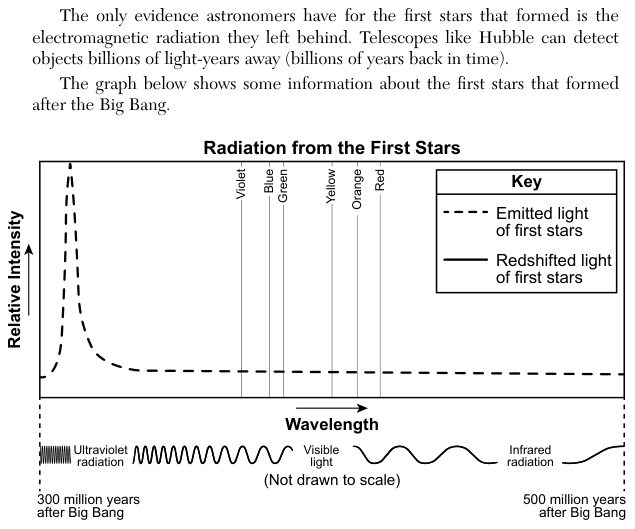
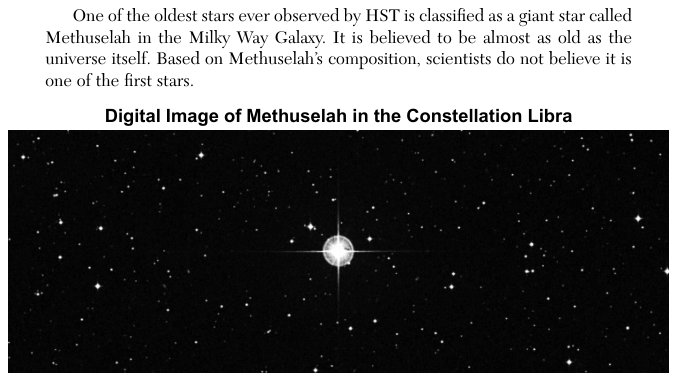
The passage says the only evidence astronomers have for the first stars is the electromagnetic radiation they left behind. A graph, Radiation from the First Stars, shows relative intensity against wavelength from ultraviolet through visible light to infrared, with a dashed line for emitted light of the first stars and a solid line for redshifted light, and labels from 300 million years to 500 million years after the Big Bang. A further paragraph and an image describe Methuselah, one of the oldest stars observed by the Hubble Space Telescope (HST), a giant star in the Milky Way Galaxy, believed to be almost as old as the universe. The passage states that, based on Methuselah's composition, scientists do not believe it is one of the first stars.
How to think about it
First recall which elements existed right after the Big Bang, before any star had formed, and so what the first stars were made of. Then compare that with the composition each choice gives for Methuselah. For each element named, think about where it could have come from, and use the Generalized Nucleosynthesis in a Massive Star model to see where elements are built.
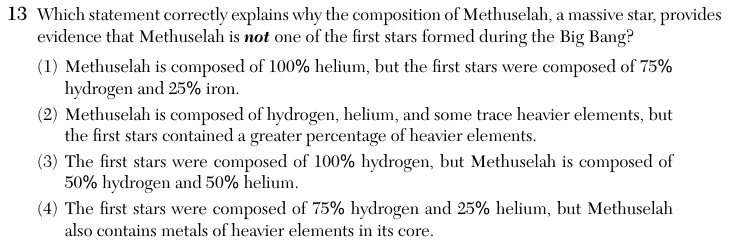
Which statement correctly explains why the composition of Methuselah, a massive star, provides evidence that Methuselah is not one of the first stars formed during the Big Bang?
Choice 4 is right. The Big Bang produced almost only hydrogen and helium, about 75% hydrogen and 25% helium by mass, so the first stars were made of these two elements. Heavier elements are made inside stars and spread into space when stars die. Methuselah contains some heavier elements, so it formed from gas that earlier stars had already enriched, and it cannot be one of the first stars. These heavier elements are seen in the star's spectrum, the light that comes from its outer layers, so 'in its core' in the choice is loose wording. The reasoning of the choice still holds.
The first stars contained no iron, because iron is made only inside stars, as the nucleosynthesis model shows. Methuselah is also not made of pure helium. This choice may come from mixing up the core of a dying massive star with the gas the first stars formed from.
This reverses the order. The first stars had almost no heavier elements, because no earlier stars existed to make them. A star with more heavier elements formed later, not earlier.
The first stars were not pure hydrogen, because the Big Bang also made a large amount of helium, about one quarter by mass. Methuselah is not half helium either. This choice may come from thinking that all helium was made later inside stars.