Earth and Space Sciences Regents, August 2025, question 11
Tap an image to open it full size.
What the figure shows
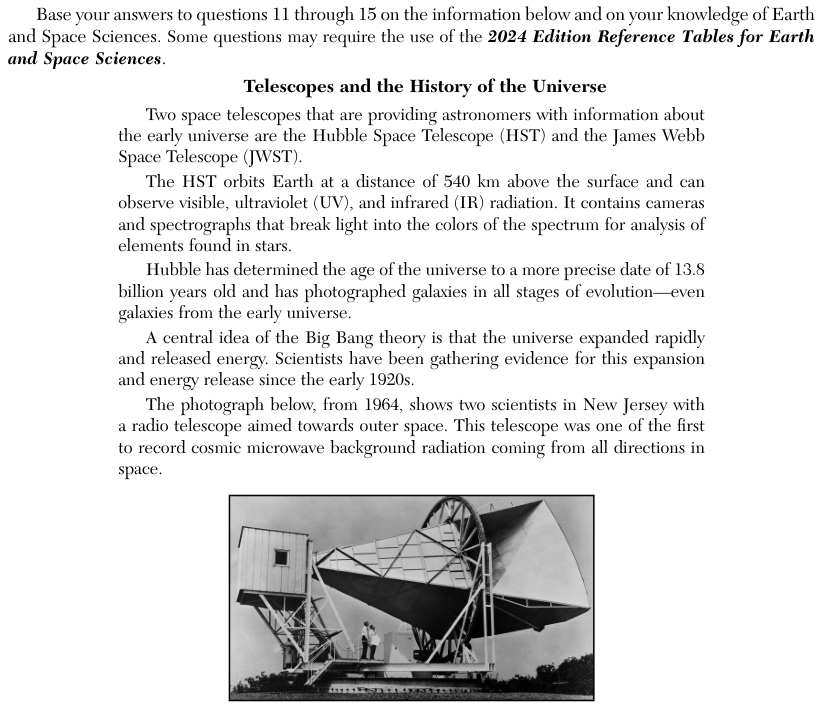
The passage, Telescopes and the History of the Universe, describes the Hubble Space Telescope (HST) and the James Webb Space Telescope (JWST). It says Hubble has determined the age of the universe as 13.8 billion years, and that a central idea of the Big Bang theory is that the universe expanded rapidly and released energy. A photograph from 1964 shows two scientists in New Jersey with a large horn-shaped radio telescope, one of the first to record cosmic microwave background radiation coming from all directions in space.
How to think about it
Recall what the Big Bang theory says about the early universe: it was very hot and dense, and it expanded. Ask what kind of energy such an event would leave behind, and where in the sky it would be found today. Read each explanation and check whether it fits what the Big Bang theory actually describes.
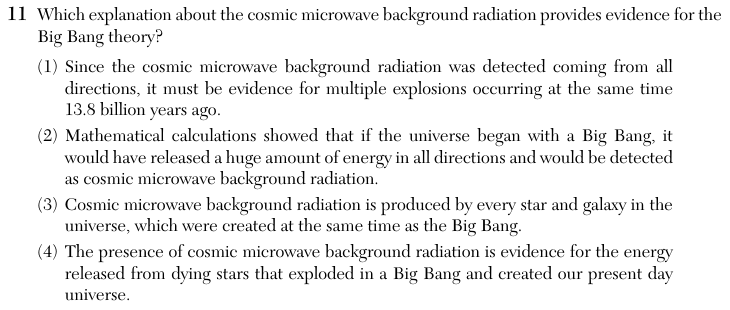
Which explanation about the cosmic microwave background radiation provides evidence for the Big Bang theory?
Choice 2 is right. Calculations based on the Big Bang theory predicted that the early hot universe would leave energy spread evenly through all of space. As the universe expanded, this energy was stretched to long microwave wavelengths. The 1964 radio telescope found this radiation coming from every direction, as the theory predicted, so it supports the Big Bang.
Radiation from all directions does not point to many separate explosions. The Big Bang was a single event in which all of space expanded at once, so its leftover energy fills the whole sky. This choice may come from picturing the Big Bang as ordinary explosions at certain places.
Cosmic microwave background radiation is not given off by stars and galaxies. It was released long before the first stars formed, which was hundreds of millions of years after the Big Bang. This choice mixes up starlight with the energy left from the early universe.
Dying stars that explode are supernovas, which happened long after the Big Bang. The Big Bang was not made of exploding stars, because no stars existed yet. This choice may come from mixing up a supernova with the beginning of the universe.