Earth and Space Sciences Regents, June 2025, question 26
Tap an image to open it full size.
What the figure shows
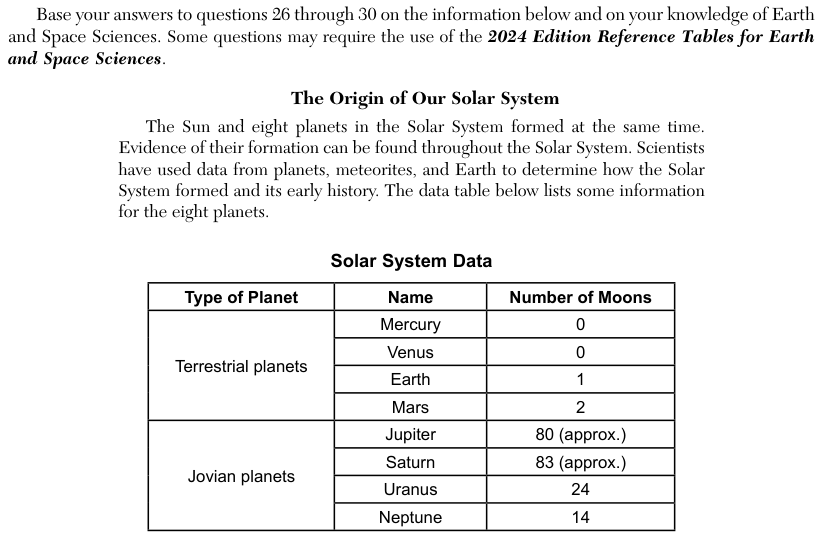
A table lists the eight planets in two groups. Mercury, Venus, Earth and Mars are terrestrial planets with 0 to 2 moons. Jupiter, Saturn, Uranus and Neptune are Jovian planets with 14 to about 83 moons. The passage says the Sun and planets formed at the same time.
How to think about it
Each choice makes two claims, and both must be true. Check each claim against the Solar System Objects Data Table, and use what you know about how each group of planets formed for any property the table does not list.
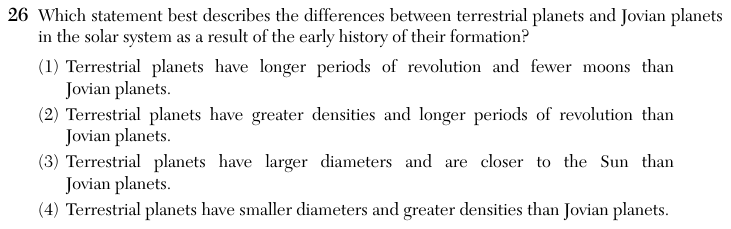
Which statement best describes the differences between terrestrial planets and Jovian planets in the solar system as a result of the early history of their formation?
Choice 4 is right. The data table shows that the terrestrial planets have equatorial diameters of about 4900 to 12,800 kilometers (km), while the Jovian planets are about 49,500 to 143,000 km across. The terrestrial planets formed close to the Sun, where only rock and metal could condense, so they are dense. The Jovian planets formed farther out, where gases and ices collected, so they are much less dense.
The terrestrial planets do have fewer moons, but they are closer to the Sun, so their periods of revolution are shorter (88 days to 1.9 years) than those of the Jovian planets (11.9 to 163.7 years). This choice mixes up distance from the Sun with orbit time.
Greater density is correct, but the periods of revolution are reversed. In the data table, every terrestrial planet takes less time to orbit the Sun than every Jovian planet.
Being closer to the Sun is correct, but the diameters are reversed. Jupiter's diameter of 142,984 kilometers (km) is more than ten times Earth's 12,756 km.