Earth and Space Sciences Regents, June 2025, question 24
Tap an image to open it full size.
What the figure shows
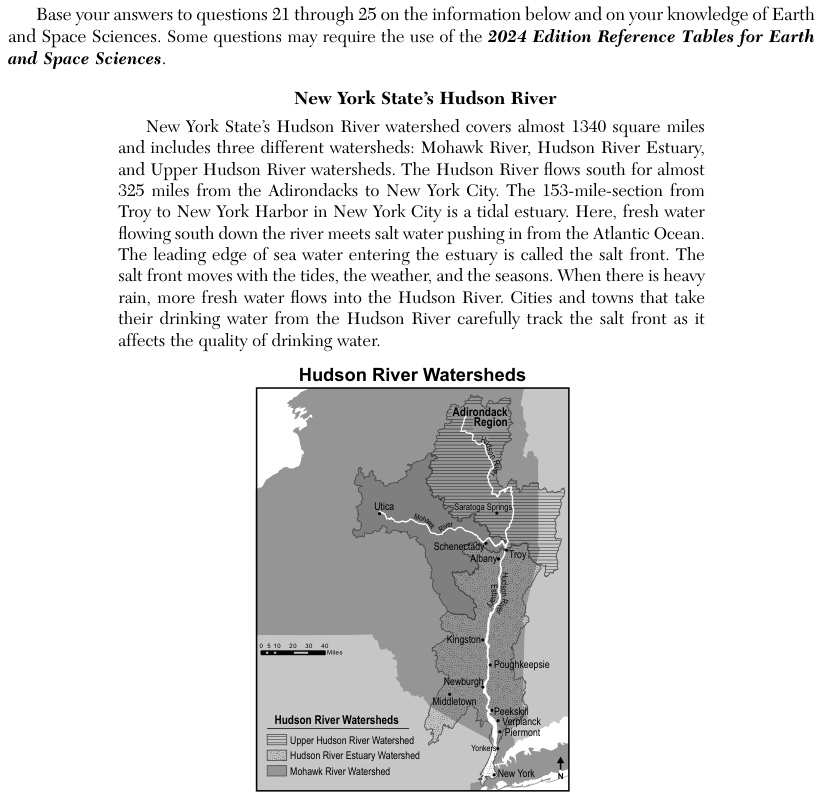
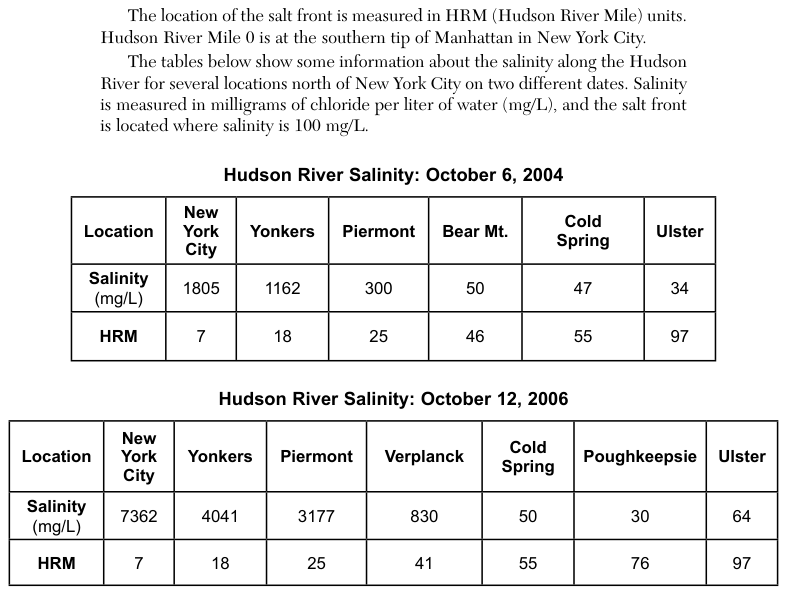
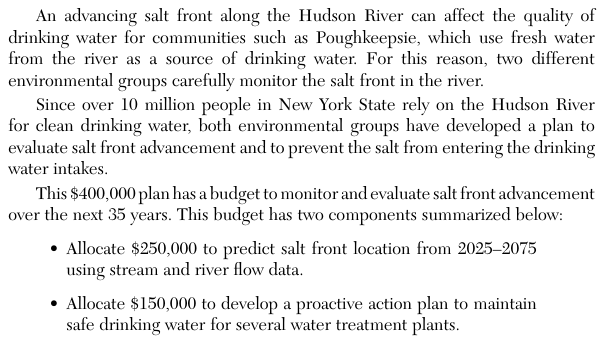
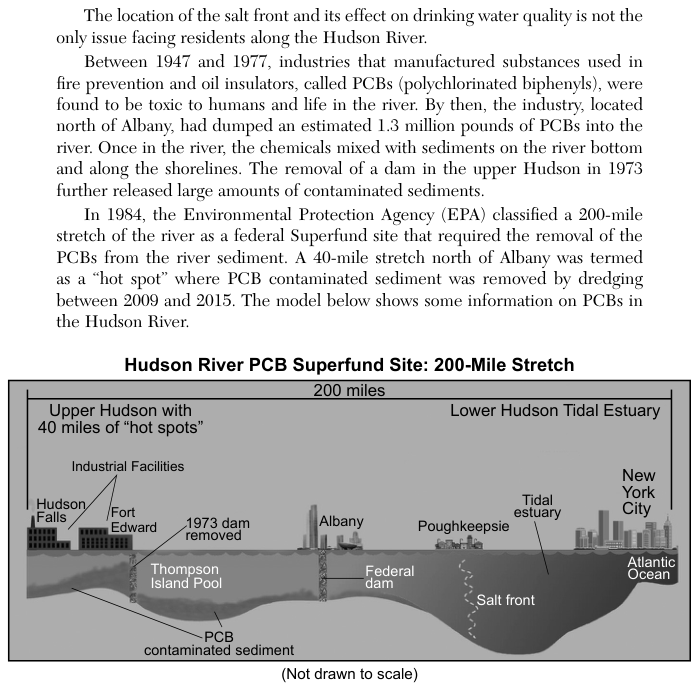
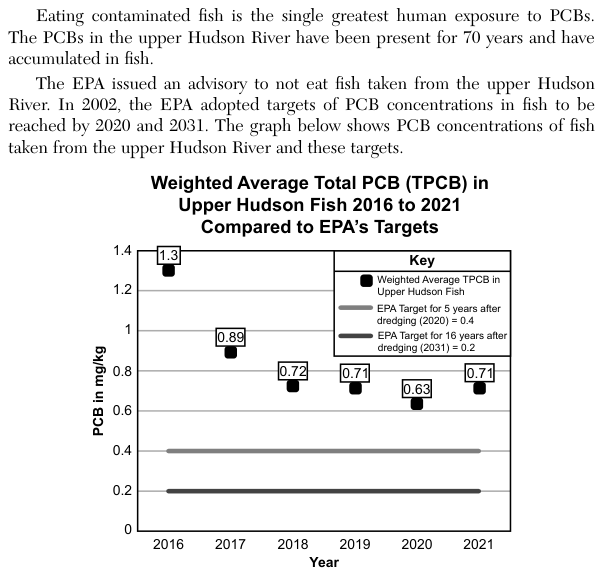
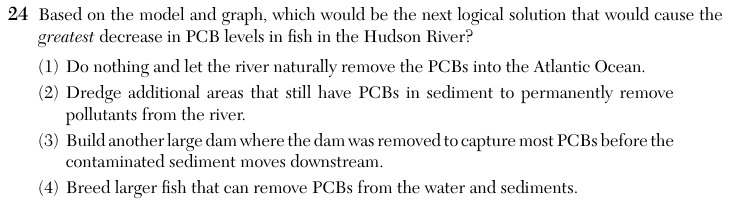
A side-view model of a 200-mile stretch of the Hudson River shows industrial sites at Hudson Falls and Fort Edward, the place where a dam was removed in 1973, Albany with a federal dam, and the tidal estuary down to New York City. A layer marked as polychlorinated biphenyl (PCB) contaminated sediment lies along the river bottom. A graph shows the weighted average total PCB in upper Hudson fish, in milligrams per kilogram (mg/kg), from 2016 to 2021, with two Environmental Protection Agency (EPA) target lines at 0.4 mg/kg for 2020 and 0.2 mg/kg for 2031. The passage says a 40-mile hot spot was dredged between 2009 and 2015.
How to think about it
First describe the trend in the graph after 2018 and compare it with the two target lines. Then use the model to find where the PCBs that remain are stored. Judge each solution by what it would do to that store of PCBs.
Based on the model and graph, which would be the next logical solution that would cause the greatest decrease in PCB levels in fish in the Hudson River?
Choice 2 is right. The model shows PCB-contaminated sediment still lying on the river bottom, and the graph shows fish levels stopped falling at about 0.7 mg/kg (milligrams per kilogram) after 2018, still above both targets. The graph starts in 2016, after dredging ended in 2015, so it shows the decline after dredging but does not by itself prove that dredging caused it. The reason to dredge the remaining contaminated areas is that the contaminated sediment is the source of the PCBs that fish take in.
The graph shows fish PCB (polychlorinated biphenyl) levels holding near 0.7 mg/kg (milligrams per kilogram) from 2018 to 2021, so the river is not clearing itself fast enough to meet the targets. Moving PCBs toward the ocean also spreads them downstream instead of removing them.
A dam can trap sediment, but the PCBs (polychlorinated biphenyls) would stay in the river behind it, where fish still take them in. This choice confuses holding the pollutant in place with removing it.
Fish take in PCBs (polychlorinated biphenyls) and store them in their bodies, which is why eating fish is the main human exposure. Larger fish would hold more PCBs, and they cannot remove the chemicals from the sediment.