Earth and Space Sciences Regents, June 2025, question 27

Tap an image to open it full size.
What the figure shows
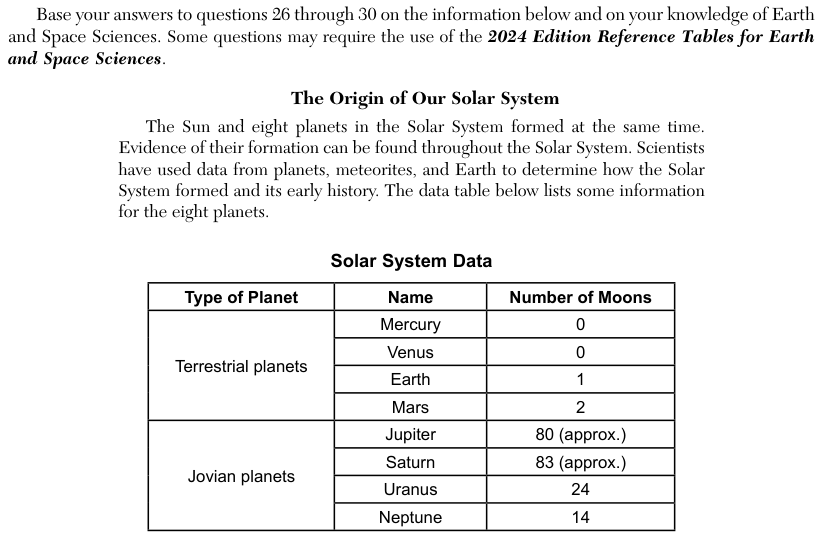
The question gives four values for the period of revolution of Saturn, in Earth days. The context passage lists the eight planets and their numbers of moons but gives no orbit data.
How to think about it
Open the Solar System Objects Data Table and find Saturn's period of revolution. Check its unit: the table gives the outer planets in Earth years, so convert to Earth days by multiplying by the number of days in one Earth year.
Which value would be the most accurate prediction for the period of revolution for Saturn?
Choice 2 is right. The table gives Saturn's period of revolution as 29.5 Earth years. Multiplying by 365.26 days per year gives about 10,775 days, and 10,759 Earth days is the closest value. Saturn takes about 29.5 years to go once around the Sun.
5358 days is about 14.7 years. That falls between Jupiter (11.9 years) and Saturn (29.5 years), so it fits a planet closer to the Sun than Saturn. It may come from treating Saturn's period as roughly half its real length.
23,560 days is about 64.5 years. That falls between Saturn (29.5 years) and Uranus (83.7 years), so it fits a planet farther from the Sun than Saturn.
28,286 days is about 77.4 years, which is close to Uranus (83.7 years) and far from Saturn. It fits a planet much farther out than Saturn. It may come from using a period close to that of Uranus instead of Saturn's 29.5 years.
Reference table: Solar System Objects Data Table (2024 edition, page 2)