Earth and Space Sciences Regents, August 2026, question 23
Tap an image to open it full size.
What the figure shows
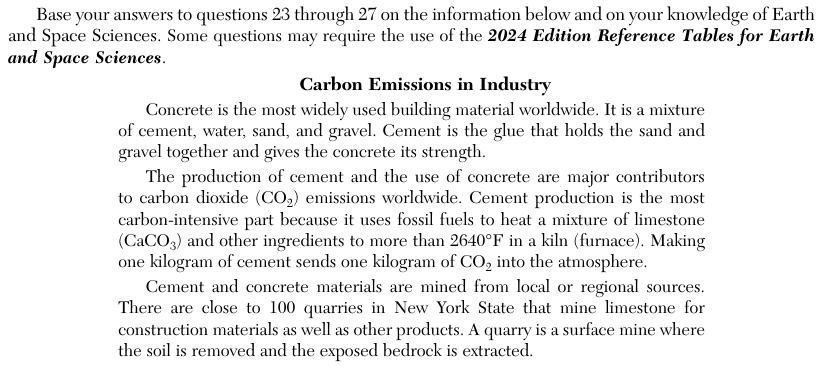
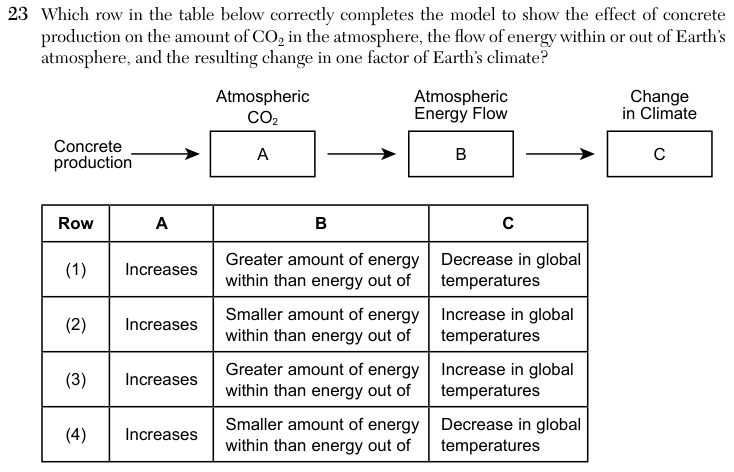
The passage says cement production uses fossil fuels to heat limestone in a kiln, and that making one kilogram of cement sends one kilogram of carbon dioxide (CO2) into the atmosphere. The question shows a chain of boxes: Concrete production, then Atmospheric CO2 (box A), then Atmospheric Energy Flow (box B), then Change in Climate (box C). A table gives four rows. All four rows put Increases in box A. Box B is either Greater amount of energy within than energy out of, or Smaller amount of energy within than energy out of. Box C is either Increase in global temperatures or Decrease in global temperatures.
How to think about it
Work through the chain one box at a time. Use the passage to decide what concrete production does to the amount of carbon dioxide in the air. Then recall what carbon dioxide does to the infrared energy that Earth's surface gives off. Last, decide what a change in the balance between energy arriving from the Sun and energy leaving to space does to temperature.
Which row in the table below correctly completes the model to show the effect of concrete production on the amount of CO2 in the atmosphere, the flow of energy within or out of Earth’s atmosphere, and the resulting change in one factor of Earth’s climate? Concrete production Atmospheric CO2 Atmospheric Energy Flow Change in Climate A B C Row A B C
Choice 3 is right. Concrete production releases carbon dioxide, so atmospheric CO2 increases. Carbon dioxide is a greenhouse gas: it absorbs infrared energy given off by Earth's surface and sends part of it back down. This reduces the energy leaving to space compared with the energy arriving from the Sun. Energy builds up, which is what box B calls a greater amount of energy within than energy out of, and global temperatures rise.
Box B is correct, but when less energy leaves to space than arrives from the Sun, energy builds up and Earth warms. It does not cool. This choice may come from linking pollution with cooling instead of following the energy balance.
A smaller amount of energy within than energy out of would mean more energy leaving to space than arriving from the Sun, and Earth would cool, not warm. More carbon dioxide traps more energy, so box B is reversed here, and box C does not follow from it.
Box B is reversed: added carbon dioxide traps more energy, not less. Box C follows from the wrong box B, so the whole chain points the wrong way.