Earth and Space Sciences Regents, August 2026, question 5
Tap an image to open it full size.
What the figure shows
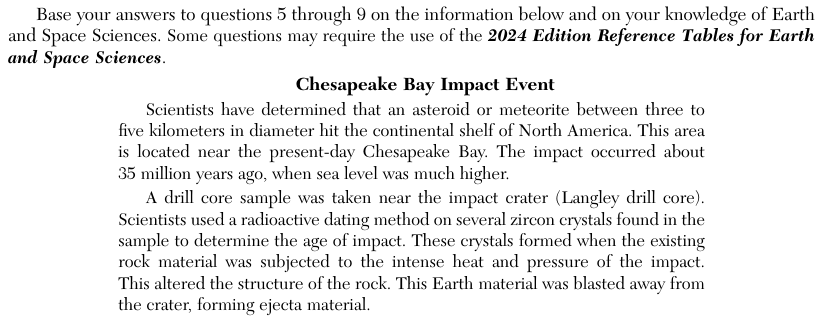
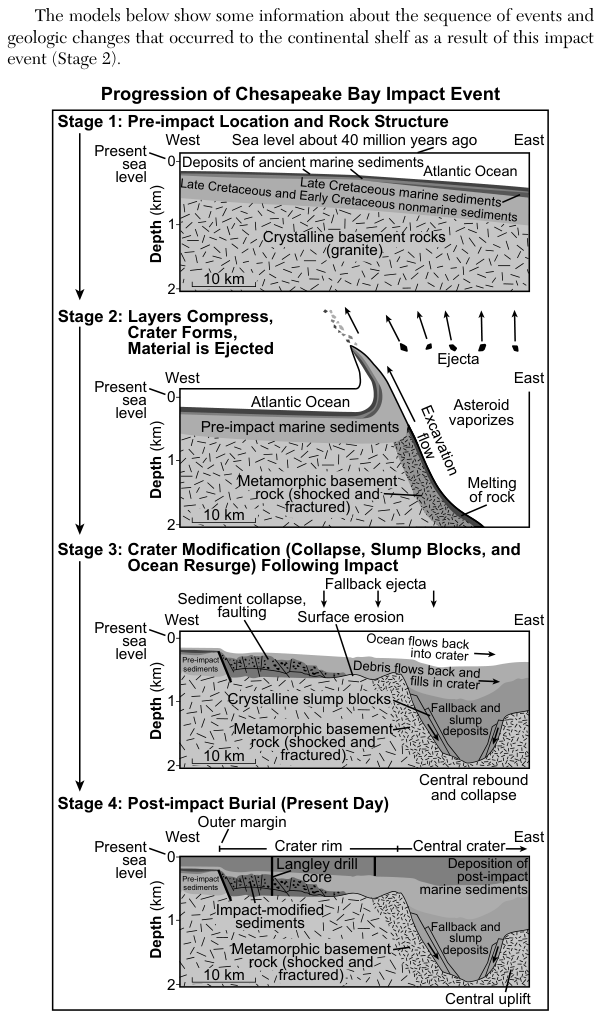
The passage says an asteroid or meteorite three to five kilometers (km) across hit the continental shelf of North America near the present-day Chesapeake Bay about 35 million years ago, when sea level was much higher. Zircon crystals from the Langley drill core, which formed under the intense heat and pressure of the impact, were dated by a radioactive method. A four-stage model, Progression of Chesapeake Bay Impact Event, shows cross sections from Stage 1 (pre-impact layers of marine sediments over crystalline basement rocks, granite) through Stage 2 (crater forms, material ejected, metamorphic basement rock labeled "shocked and fractured", melting of rock), Stage 3 (collapse, slump blocks, ocean flows back) and Stage 4 (present day, post-impact marine sediments over the crater, with the shocked and fractured metamorphic basement rock below).
How to think about it
The claim is about one event, an impact. Read each piece of evidence in the choices and find where it appears in the passage or in the models. Use the labels in the Stage 1 and Stage 2 models to see which materials existed before the impact and which the impact itself produced.
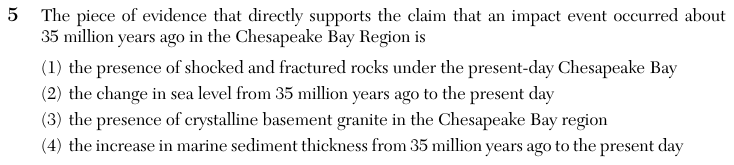
The piece of evidence that directly supports the claim that an impact event occurred about 35 million years ago in the Chesapeake Bay Region is
Choice 1 is right. Rock that is shocked and fractured forms under very sudden, intense pressure, such as a large impact. The Stage 2 and Stage 4 models show this shocked and fractured metamorphic basement rock under the crater, where it remains today. The zircon crystals dated to about 35 million years ago formed in this impact-altered rock.
Sea level rises and falls for many reasons, such as the melting and growth of ice sheets and movements of the crust. A change in sea level does not point to an impact, so it is not direct evidence of one.
The crystalline basement granite was already there before the impact, as the Stage 1 model shows. Granite forms from magma cooling slowly deep in the crust, so its presence says nothing about an impact. This choice may come from mixing up the original granite with the shocked rock the impact made from it.
Marine sediments build up on continental shelves with or without an impact. Thicker sediment since 35 million years ago shows burial over time, as in Stage 4, but it does not show that an impact happened.