Earth and Space Sciences Regents, June 2026, question 28
Tap an image to open it full size.
What the figure shows
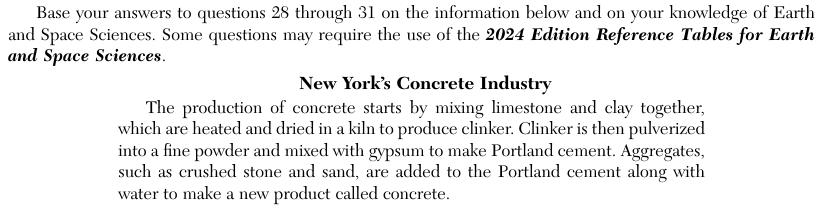
The passage, New York's Concrete Industry, says that concrete starts by mixing limestone and clay, which are heated and dried in a kiln to make clinker. Clinker is ground into a fine powder and mixed with gypsum to make Portland cement, and aggregates (crushed stone and sand) and water are added to make concrete. The question gives four resources, each paired with a region of New York State.
How to think about it
Open the Energy and Mineral Resources of New York State map and find the letter symbol for cement and the shading or symbol for each resource named. Then open the Geographic Province and Landscape Regions of New York State map to see where each named region lies. Check each pair: is that resource shown in that region, and is cement made there?
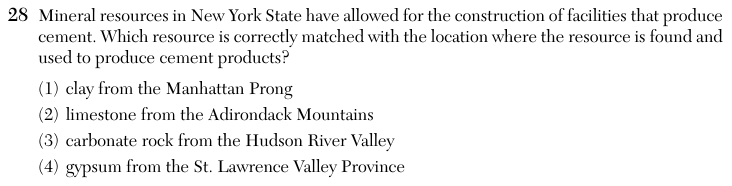
Mineral resources in New York State have allowed for the construction of facilities that produce cement. Which resource is correctly matched with the location where the resource is found and used to produce cement products?
Choice 3 is right. On the Energy and Mineral Resources map, carbonate rock (shaded gray) runs along the Hudson River Valley, and the symbol C for cement appears there near Kingston, Albany and Glens Falls. Limestone is a carbonate rock, so this resource is found and used for cement in the same place.
The Manhattan Prong is the small region around New York City. The resource map shows no clay (Cl) symbol and no cement symbol there. It may come from placing the clay symbols near Kingston and West Point in the wrong region.
The resource map shows garnet, wollastonite, iron, zinc, talc and other minerals in the Adirondack Mountains, but no carbonate rock shading and no cement symbol there. The Adirondacks are made of old igneous and metamorphic rocks, not limestone.
The gypsum symbol (G) and the area underlain by gypsum are in western and central New York, near Buffalo and south of Lake Ontario. The St. Lawrence Valley Province has carbonate rock but no gypsum symbol. It may come from mixing up the two lowland regions along the northern edge of the state.