Earth and Space Sciences Regents, June 2026, question 19
Tap an image to open it full size.
What the figure shows
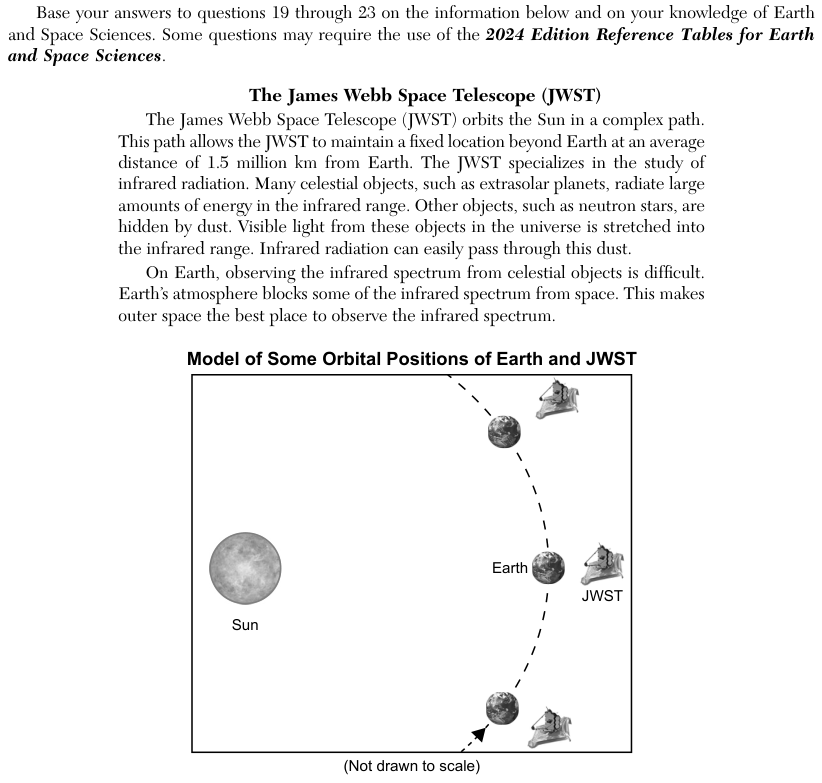
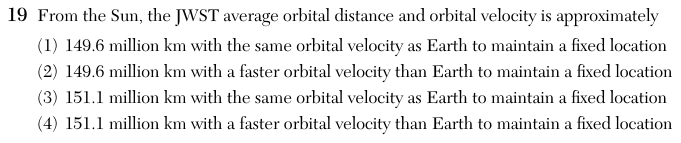
The passage says the James Webb Space Telescope (JWST) orbits the Sun and keeps a fixed location beyond Earth, at an average distance of 1.5 million kilometers (km) from Earth. The model, Model of Some Orbital Positions of Earth and JWST (not drawn to scale), shows the Sun on the left and Earth at three positions along a dashed curved path around it. At each position the JWST is drawn beyond Earth, on the side away from the Sun. The four choices give a distance from the Sun of 149.6 or 151.1 million km, each with an orbital velocity either the same as or faster than Earth's.
How to think about it
Open the Solar System Objects Data Table and find Earth's mean distance from the Sun. Use the model to decide whether the telescope's distance from Earth adds to or subtracts from that value. Then think about speed: compare how long each object takes to go once around the Sun, and how long a path each one travels in that time.
From the Sun, the JWST average orbital distance and orbital velocity is approximately
Choice 4 is right. Earth's mean distance from the Sun is 149.6 million km, and the JWST sits 1.5 million km farther out, so its distance is 149.6 + 1.5 = 151.1 million km. To stay at a fixed location beyond Earth, the JWST must go around the Sun once in the same time as Earth, one year. Its circle is larger, so it must cover a longer path in that same year, which needs a faster orbital velocity than Earth's.
149.6 million km is Earth's own distance from the Sun, not the telescope's. This choice may come from forgetting to add the 1.5 million km between Earth and the JWST. It also treats the same time for one orbit as the same speed.
The faster speed is correct, but 149.6 million km is Earth's distance from the Sun. The JWST is 1.5 million km beyond Earth, so its distance is larger.
The distance is correct, but the speed is not. The JWST takes the same time as Earth to go around the Sun on a larger circle, so it must move faster. This choice may come from mixing up the same orbital period with the same orbital velocity.