Earth and Space Sciences Regents, June 2026, question 12
Tap an image to open it full size.
What the figure shows
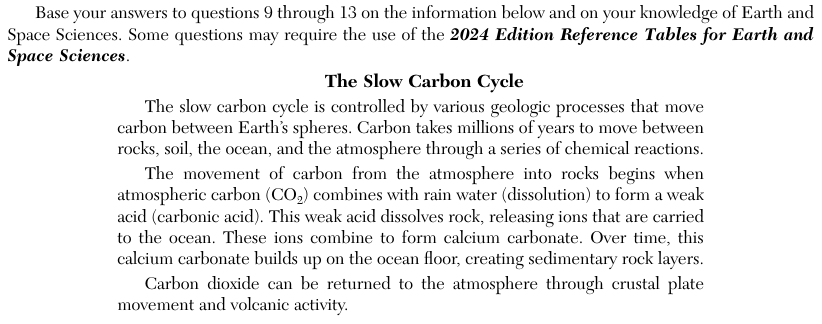
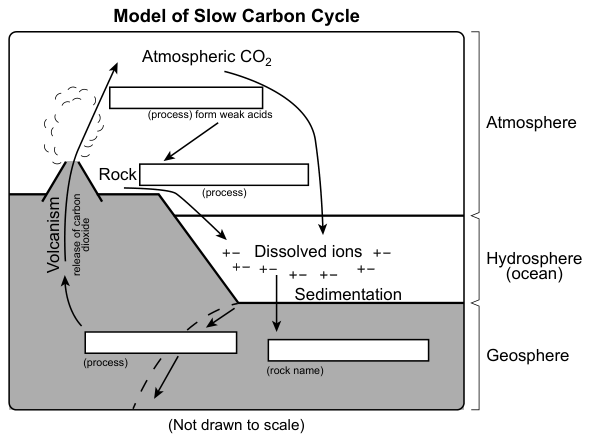
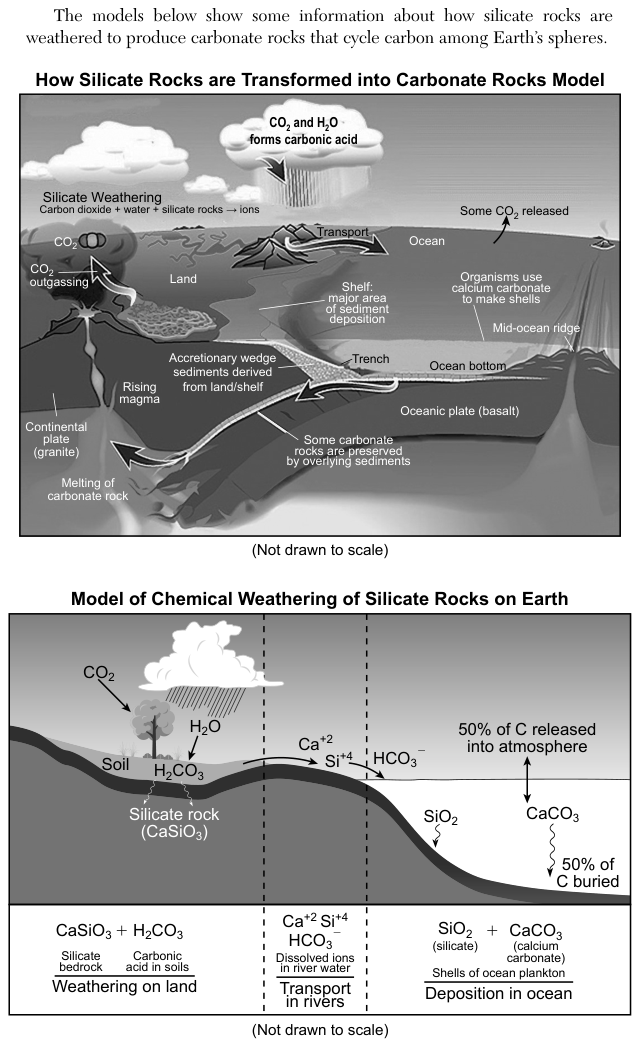
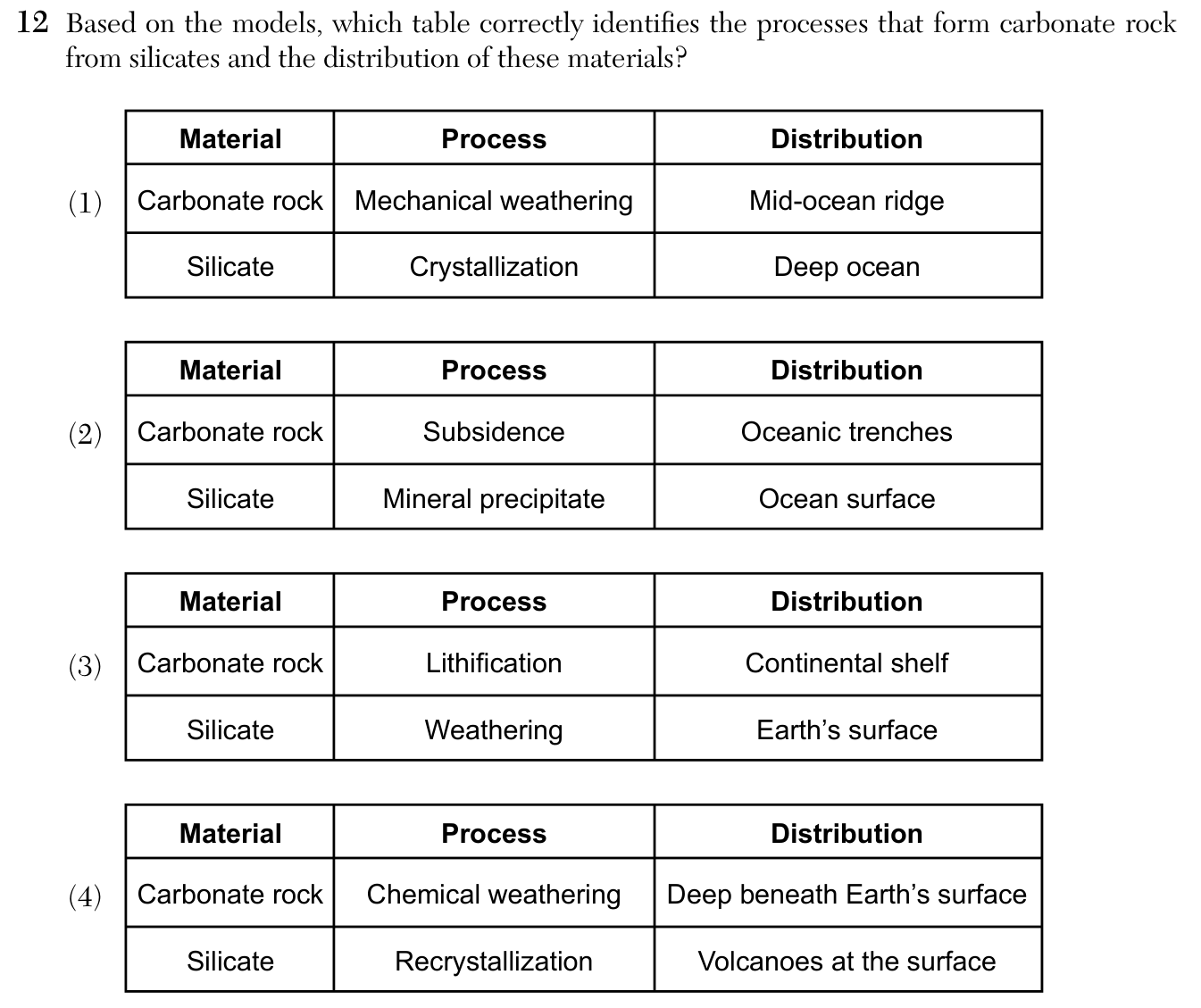
The passage The Slow Carbon Cycle says that atmospheric carbon dioxide (CO2) combines with rain water to form a weak acid (carbonic acid), which dissolves rock and releases ions that are carried to the ocean; these ions combine to form calcium carbonate, which builds up on the ocean floor as sedimentary rock layers. The How Silicate Rocks are Transformed into Carbonate Rocks Model shows silicate weathering on land (carbon dioxide + water + silicate rocks give ions), transport to the ocean, a shelf labelled 'major area of sediment deposition', organisms using calcium carbonate to make shells, a mid-ocean ridge, a trench, and 'melting of carbonate rock' deep below a continental plate near rising magma. The Model of Chemical Weathering of Silicate Rocks shows weathering on land, transport in rivers and deposition in the ocean. Each of the four choices is a small table with columns Material, Process and Distribution and two rows. Choice 1: Carbonate rock, Mechanical weathering, Mid-ocean ridge; Silicate, Crystallization, Deep ocean. Choice 2: Carbonate rock, Subsidence, Oceanic trenches; Silicate, Mineral precipitate, Ocean surface. Choice 3: Carbonate rock, Lithification, Continental shelf; Silicate, Weathering, Earth's surface. Choice 4: Carbonate rock, Chemical weathering, Deep beneath Earth's surface; Silicate, Recrystallization, Volcanoes at the surface.
How to think about it
Treat each row as a claim and test it against the models. For each row, check the process against what the models show happening to that material. Then check the place against where the models show that process taking place.
Based on the models, which table correctly identifies the processes that form carbonate rock from silicates and the distribution of these materials?
Choice 3 is right. Silicate rock is weathered at Earth's surface, where carbonic acid in soil water dissolves it into ions. The first model labels the continental shelf as the major area of sediment deposition, and there carbonate shells and sediment are buried, compacted and cemented. That process is lithification, which turns carbonate sediment into carbonate rock.
Mechanical weathering breaks rock into pieces; it does not make carbonate rock, and the models show carbonate rock forming from dissolved ions. Crystallization of silicate at a mid-ocean ridge makes new oceanic crust (basalt), which is not part of the path from silicate to carbonate rock. This choice may come from linking the mid-ocean ridge label to rock formation in general.
Subsidence at an oceanic trench carries carbonate rock down and away, toward the place where the model shows carbonate rock melting, so it does not form carbonate rock. Silicate rock in this cycle is weathered on land, not precipitated at the ocean surface. This choice may come from mixing up where carbonate rock ends up with where it forms.
Chemical weathering breaks rock down; it does not build carbonate rock. Deep beneath the surface is where the model shows carbonate rock melting, and volcanoes return carbon dioxide to the air. This choice may come from reading the cycle backward, from carbonate rock to silicate.