Earth and Space Sciences Regents, January 2026, question 2

Tap an image to open it full size.
What the figure shows
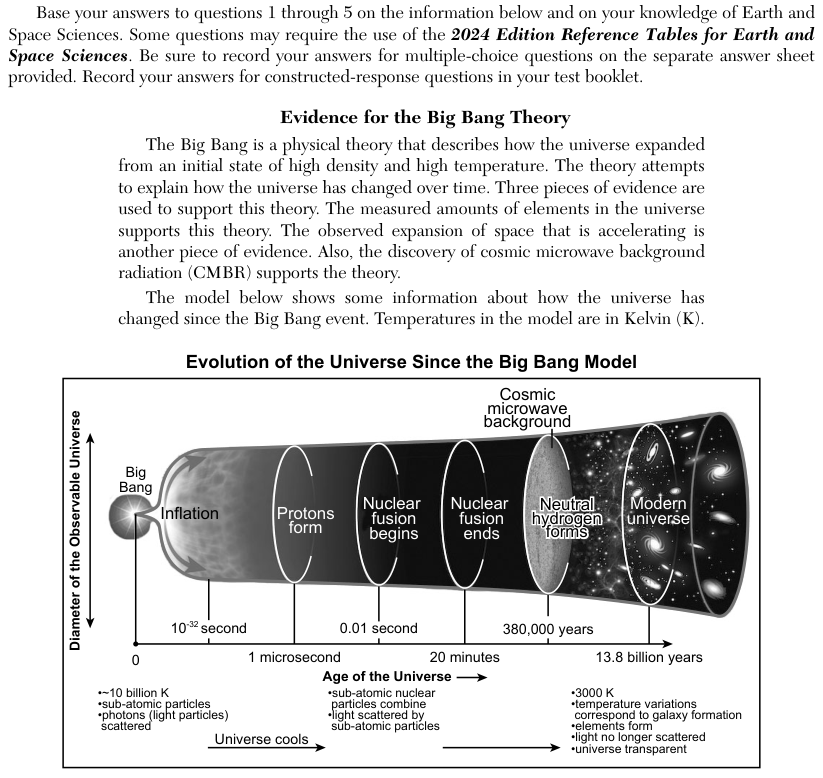
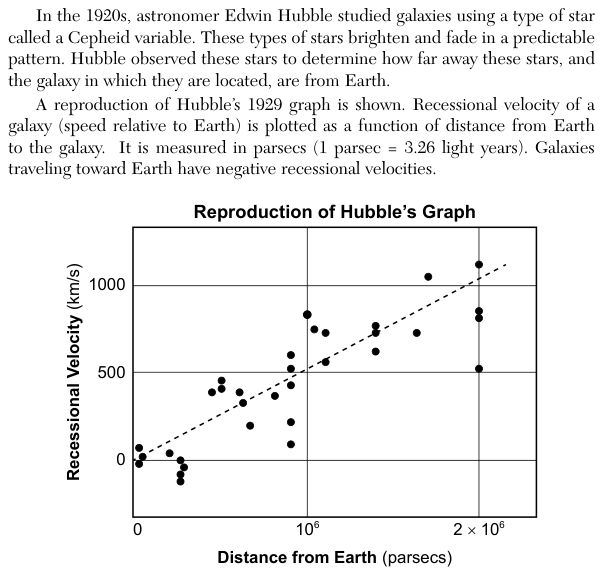
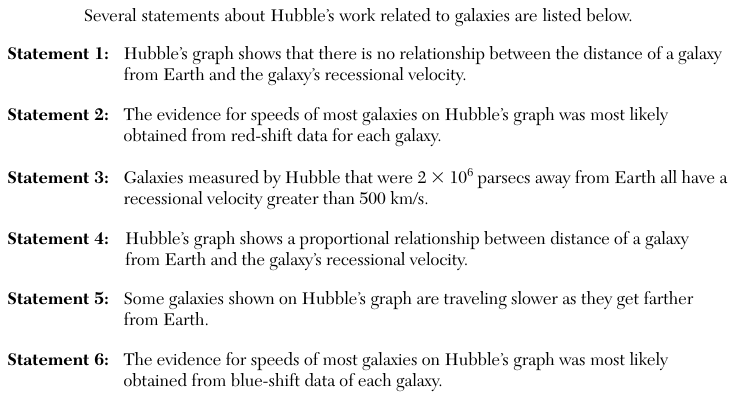
The passage says three pieces of evidence support the Big Bang theory: the measured amounts of elements, the observed accelerating expansion of space, and cosmic microwave background radiation. A reproduction of Hubble's 1929 graph plots recessional velocity in kilometers per second (km/s) against distance from Earth in parsecs (0 to 2 x 10^6). The points spread around a dashed line that rises from near 0 km/s close to Earth to about 1100 km/s at 2 x 10^6 parsecs; a few galaxies near Earth have negative values, and the four galaxies at 2 x 10^6 parsecs plot at about 520, 810, 850 and 1120 km/s. Six statements follow: (1) no relationship between distance and recessional velocity; (2) the speeds were most likely obtained from red-shift data; (3) galaxies at 2 x 10^6 parsecs all have a recessional velocity greater than 500 km/s; (4) a proportional relationship between distance and recessional velocity; (5) some galaxies are traveling slower as they get farther from Earth; (6) the speeds were most likely obtained from blue-shift data.
How to think about it
Check each of the six statements one at a time against the graph and the passage, and mark it true or false. For the two statements about how the speeds were measured, think about what happens to the light of a galaxy moving away from Earth. The right choice lists only true statements.
Which statements correctly summarize Hubble’s data as evidence to support the Big Bang Theory?