Earth and Space Sciences Regents, August 2025, question 21
Tap an image to open it full size.
What the figure shows
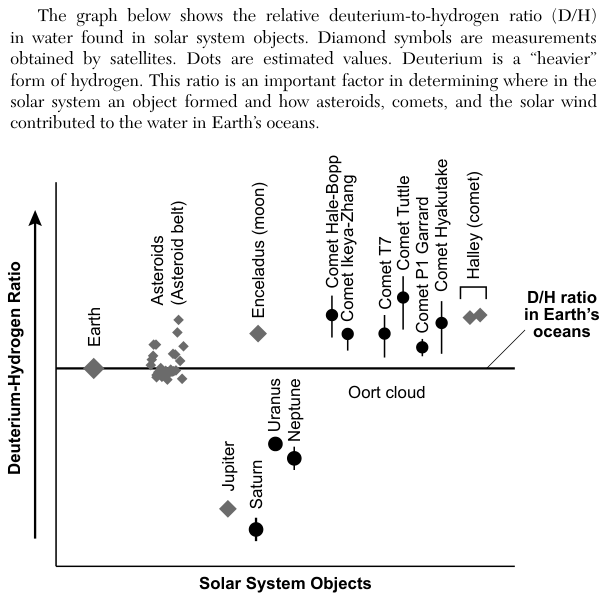
The passage gives three ideas for where Earth's water came from: comets, asteroids, and dust particles carrying hydrogen from the solar wind. A graph plots the deuterium-to-hydrogen ratio (D/H ratio) of water in solar system objects on the vertical axis, with the objects named along the horizontal axis. Diamonds are satellite measurements and dots are estimated values. A horizontal line marks the D/H ratio in Earth's oceans. Earth sits on the line. A cluster of asteroid points (Asteroid belt) sits on and slightly above the line. Enceladus (a moon), seven named comets and Halley sit above the line, with Oort cloud printed under the comets. Jupiter, Saturn, Uranus and Neptune sit below the line.
How to think about it
To refute a claim, a statement must give evidence that points away from it. Start by finding the line for Earth's oceans on the graph. Then compare how far the comets plot from that line with how far each other group of objects plots from it.
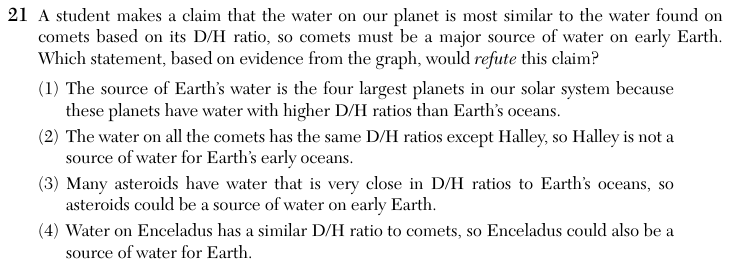
A student makes a claim that the water on our planet is most similar to the water found on comets based on its D/H ratio, so comets must be a major source of water on early Earth. Which statement, based on evidence from the graph, would refute this claim?
Choice 3 is right. On the graph, most asteroid points sit on or very close to the line for Earth's oceans, while every comet plots well above it. So the asteroids, not the comets, are the closest match to Earth's water. This evidence goes against the claim that comets must be a major source.
Jupiter, Saturn, Uranus and Neptune all plot below the ocean line, so their D/H ratios are lower than Earth's oceans, not higher. This choice may come from reading the vertical axis upside down.
The comets do not share one D/H ratio. Their points sit at different heights, and all of them, Halley included, are above the ocean line. Even if the statement were true, ruling out Halley alone would not argue against comets as a group. This choice may come from seeing the comets grouped under one label and treating their points as one value.
Enceladus does plot above the ocean line, near the comets. But that makes Enceladus a poor match for Earth's water too, and the statement says nothing against comets. It adds a possible source without refuting the claim. This choice may come from treating any object that plots near the comets as evidence about the claim.