Earth and Space Sciences Regents, August 2025, question 8
Tap an image to open it full size.
What the figure shows
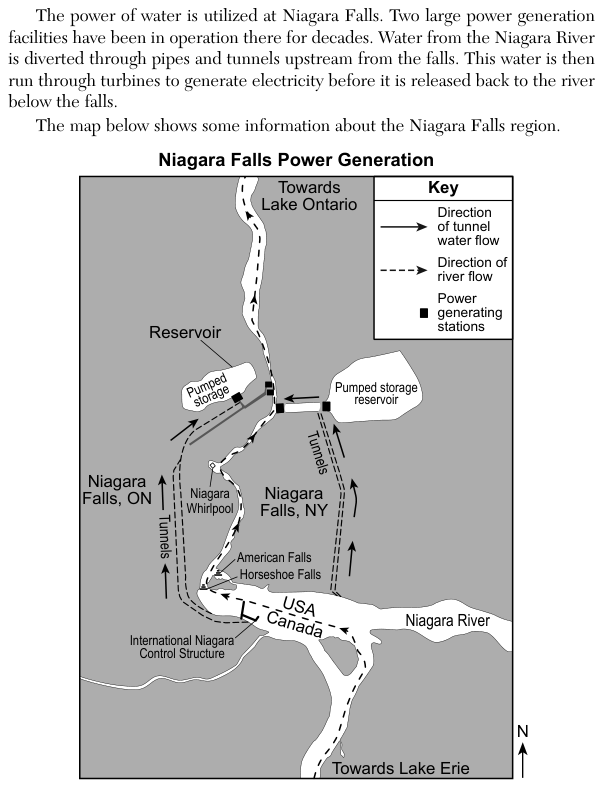
The passage says that at Niagara Falls, water from the Niagara River is sent through pipes and tunnels upstream from the falls, run through turbines to generate electricity, and then released back to the river below the falls. The map Niagara Falls Power Generation shows the river flowing from Lake Erie toward Lake Ontario, tunnels on the Canadian and the United States sides, pumped storage reservoirs and power generating stations. A map shows the edge of Horseshoe Falls retreating upstream from 1678 to 1964, and a bar graph compares Energy Return on Investment for seven electricity sources.
How to think about it
Each choice makes two claims: a change in the atmosphere, and an effect on climate. Compare what happens in a fossil-fuel plant and in a hydroelectric plant. Then, for each choice, check both the change it claims in the atmosphere and the climate effect it claims.
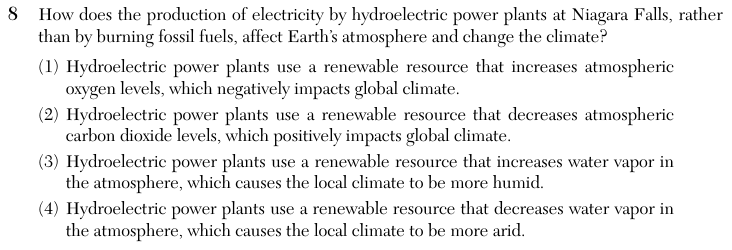
How does the production of electricity by hydroelectric power plants at Niagara Falls, rather than by burning fossil fuels, affect Earth’s atmosphere and change the climate?
Choice 2 is right. Burning coal, oil or natural gas releases carbon dioxide, a greenhouse gas that traps heat and warms the climate. A hydroelectric plant turns the energy of falling water into electricity without burning anything, so it releases far less carbon dioxide than a fossil-fuel plant making the same electricity. Replacing one with the other lowers emissions, so less carbon dioxide is added to the atmosphere than with fossil fuels. Less added carbon dioxide means less warming than the fossil-fuel choice would cause, which is the positive effect on global climate.
A hydroelectric plant does not produce oxygen; the water only turns turbines. Oxygen is also not a greenhouse gas, so a change in oxygen is not the link between power plants and climate change. This choice may come from linking plants and water with oxygen, as in photosynthesis.
The water passes through tunnels and turbines as a liquid and returns to the river below the falls, as the passage says. The plants do not add a meaningful amount of water vapor to the air. This choice may come from linking any use of water with a more humid climate.
The plants do not remove water vapor from the atmosphere; the water stays in the river system. This choice may come from thinking that water taken from the river is lost from the local water cycle.