Earth and Space Sciences Regents, August 2025, question 7
Tap an image to open it full size.
What the figure shows
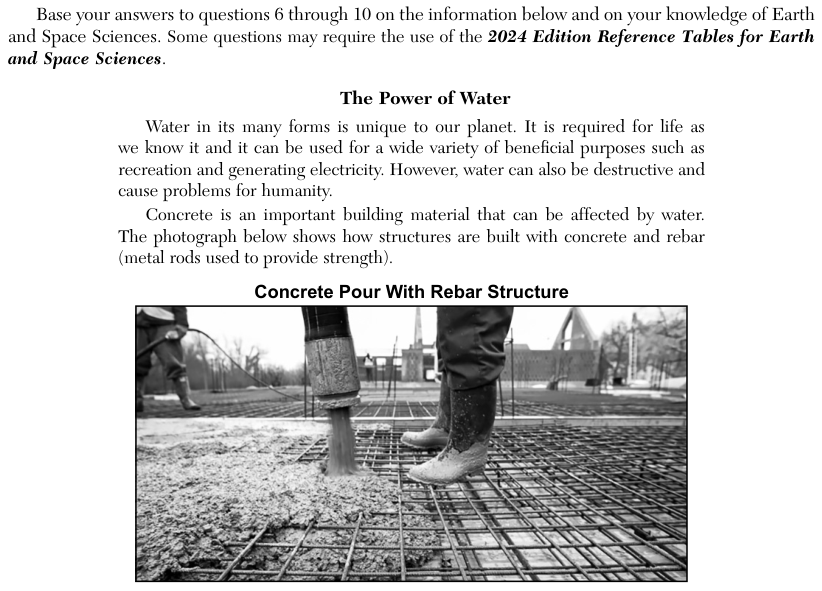
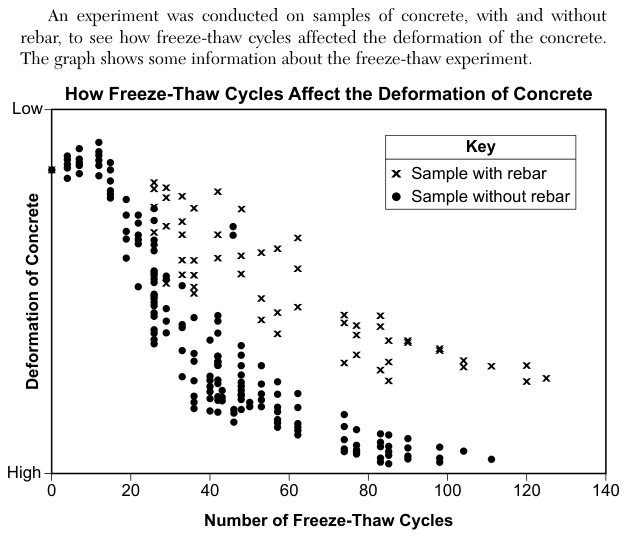
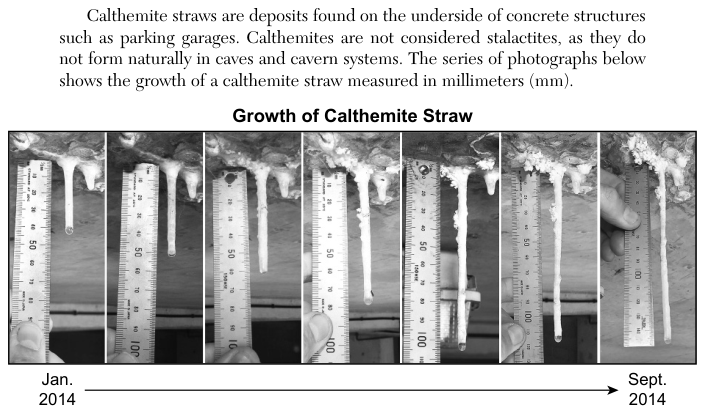
The passage, The Power of Water, says concrete is a building material that can be affected by water, and a photograph shows concrete poured over rebar (metal rods used to provide strength). A graph shows deformation of concrete increasing with the number of freeze-thaw cycles, for samples with and without rebar. A further passage says calthemite straws are deposits found on the underside of concrete structures such as parking garages, and that they are not considered stalactites because they do not form naturally in caves. A series of photographs beside a ruler in millimeters (mm) shows one calthemite straw growing longer from January 2014 to September 2014.
How to think about it
Think about what water does to minerals as it seeps through concrete, and what happens to those minerals when the water reaches the underside and drips. Each claim has two process words, one for picking up the minerals and one for leaving them. Check that both words describe a real process for minerals carried by water.
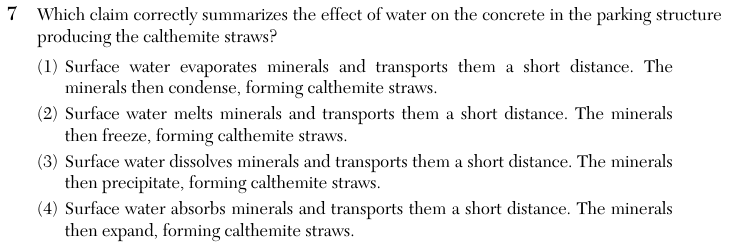
Which claim correctly summarizes the effect of water on the concrete in the parking structure producing the calthemite straws?
Choice 3 is right. Water seeping through concrete dissolves some of its minerals, mainly calcium compounds, and carries them in solution to the underside of the structure. When a drop hangs there, some water evaporates and the solution reacts with carbon dioxide in the air. The minerals come out of solution as a solid (they precipitate), and the straw grows a little longer with each drop.
Evaporation and condensation are changes of water between liquid and gas. The solid minerals in concrete do not evaporate at the temperature of a parking garage. This choice may come from mixing up what happens to the water with what happens to the minerals.
Melting needs temperatures far higher than those in a parking garage, and the minerals do not freeze to form the straw. This choice may come from the freeze-thaw graph, which is about damage to concrete, not about how calthemite straws form.
Water carries minerals by dissolving them, not by absorbing them, and the straw grows as new mineral is added at its tip, not by expanding. This choice may come from confusing it with water that soaks into concrete and expands when it freezes.