Earth and Space Sciences Regents, June 2025, question 17
Tap an image to open it full size.
What the figure shows
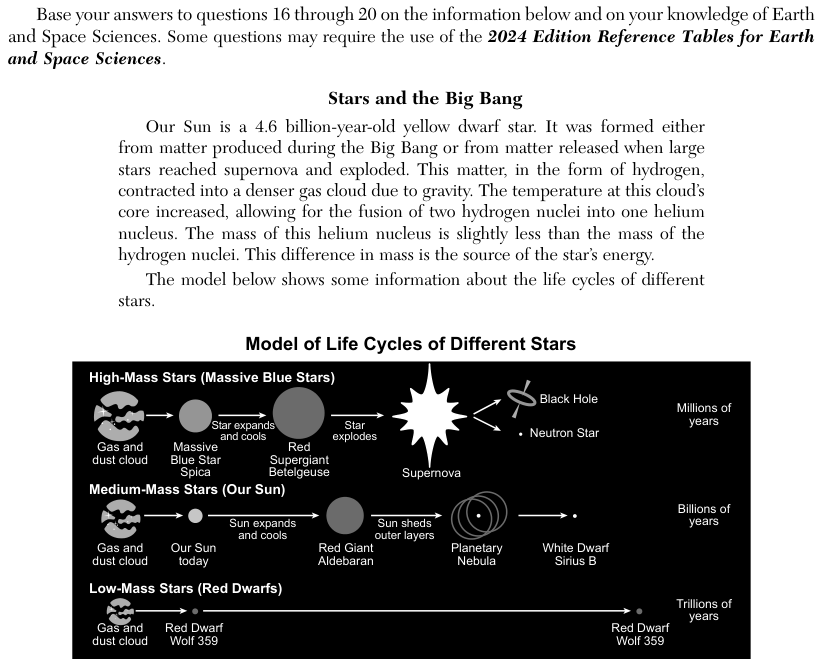
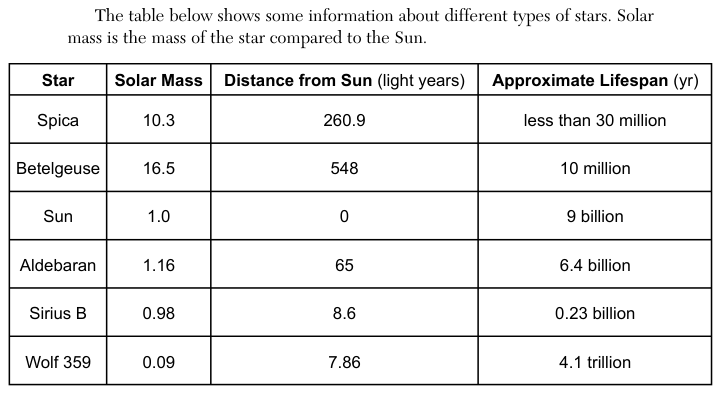
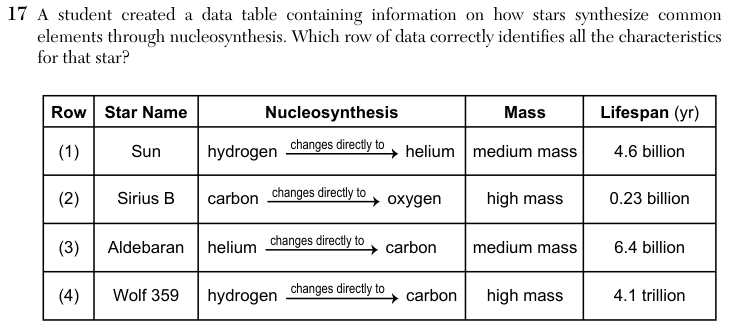
The Model of Life Cycles of Different Stars shows three paths. High-mass stars (for example Spica and Betelgeuse) become red supergiants, then a supernova, then a black hole or a neutron star, over millions of years. Medium-mass stars like our Sun become a red giant (for example Aldebaran), then a planetary nebula, then a white dwarf (for example Sirius B), over billions of years. Low-mass red dwarfs (for example Wolf 359) last trillions of years. A data table gives each star's solar mass and approximate lifespan in years: Sun 1.0 and 9 billion, Aldebaran 1.16 and 6.4 billion, Sirius B 0.98 and 0.23 billion, Wolf 359 0.09 and 4.1 trillion. The passage says the Sun is 4.6 billion years old. The question table gives four rows, each with a star name, a fusion step, a mass group and a lifespan.
How to think about it
Check each row against three sources: the life cycle model gives the mass group and stage of each star, the data table gives the lifespan, and the reference table on nucleosynthesis gives which element changes into which. A row is correct only if every cell matches. Watch the difference between a star's age and its lifespan.
A student created a data table containing information on how stars synthesize common elements through nucleosynthesis. Which row of data correctly identifies all the characteristics for that star? Row Star Name Sun medium mass high mass medium mass high mass 4.6 billion 0.23 billion 6.4 billion 4.1 trillion
Reference table: Generalized Nucleosynthesis in a Massive Star (2024 edition, page 2)