Earth and Space Sciences Regents, June 2025, question 12
Tap an image to open it full size.
What the figure shows
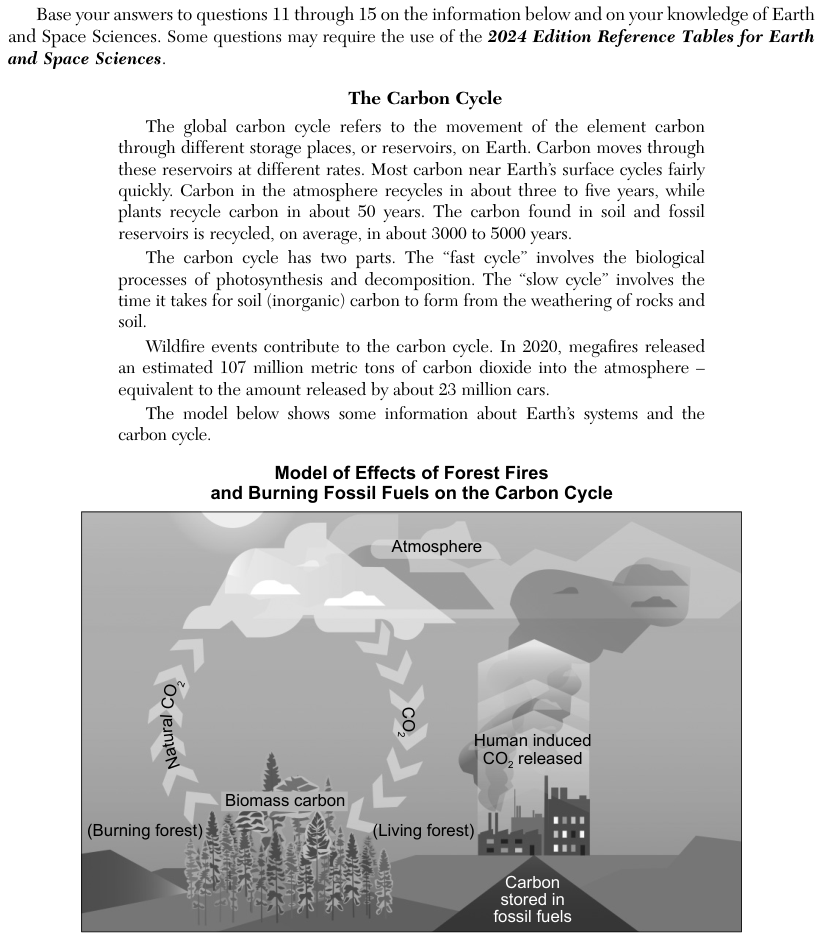
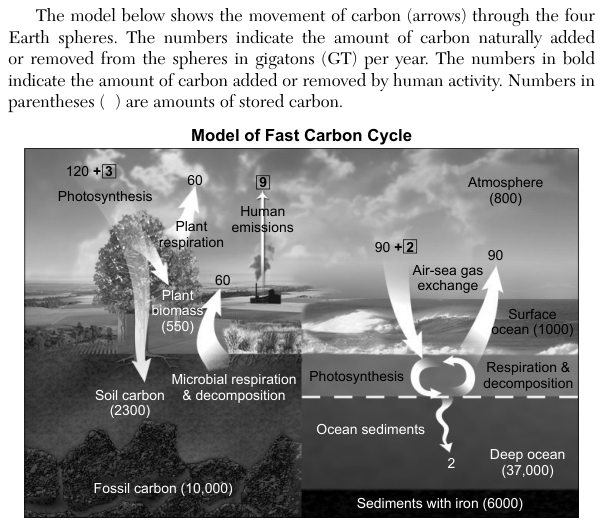
The Model of Fast Carbon Cycle shows the atmosphere, the land, the surface ocean and the deep ocean, with arrows for the movement of carbon. Numbers on the arrows are gigatons (GT) of carbon moved each year; numbers in a box are the extra amount from human activity, and numbers in parentheses are amounts stored. Labels include photosynthesis 120 plus 3, plant respiration 60, microbial respiration and decomposition 60, human emissions 9, air-sea gas exchange 90 plus 2 into the ocean and 90 out of it, and 2 going down to ocean sediments. Stored amounts include atmosphere (800), plant biomass (550), soil carbon (2300), fossil carbon (10,000), surface ocean (1000), deep ocean (37,000) and sediments with iron (6000).
How to think about it
First separate the two kinds of numbers: a flow on an arrow (carbon moved each year) and a store in parentheses (carbon held in one place). Then check each statement: is the number a flow or a store, does the arrow point in the direction the statement claims, and does the arithmetic work? For a flow into a sphere, add the natural number and the boxed human number.
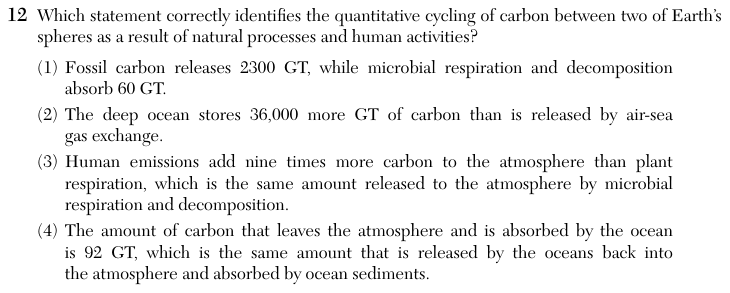
Which statement correctly identifies the quantitative cycling of carbon between two of Earth’s spheres as a result of natural processes and human activities?
Choice 4 is right. Carbon leaving the atmosphere into the ocean is 90 GT from natural exchange plus 2 GT caused by humans, a total of 92 GT. On the other side, the ocean releases 90 GT back to the atmosphere and sends 2 GT down to the ocean sediments, also 92 GT. The flows in and out of the ocean match.
This choice reads stores as flows. The 2300 GT is carbon stored in soil, not a yearly release from fossil carbon, and the 60 GT arrow from microbial respiration and decomposition points up into the atmosphere, so it is a release, not an uptake.
This choice mixes a stored amount with a yearly flow. The deep ocean stores 37,000 GT (gigatons) of carbon, while air-sea gas exchange moves 90 GT per year. A store and a yearly flow cannot be subtracted from each other. The 36,000 GT in the choice does not match any value on the diagram.
This choice reverses the comparison. Human emissions add 9 GT a year while plant respiration adds 60 GT, so plant respiration is the larger flow, between six and seven times the human amount.