Earth and Space Sciences Regents, June 2025, question 6
Tap an image to open it full size.
What the figure shows
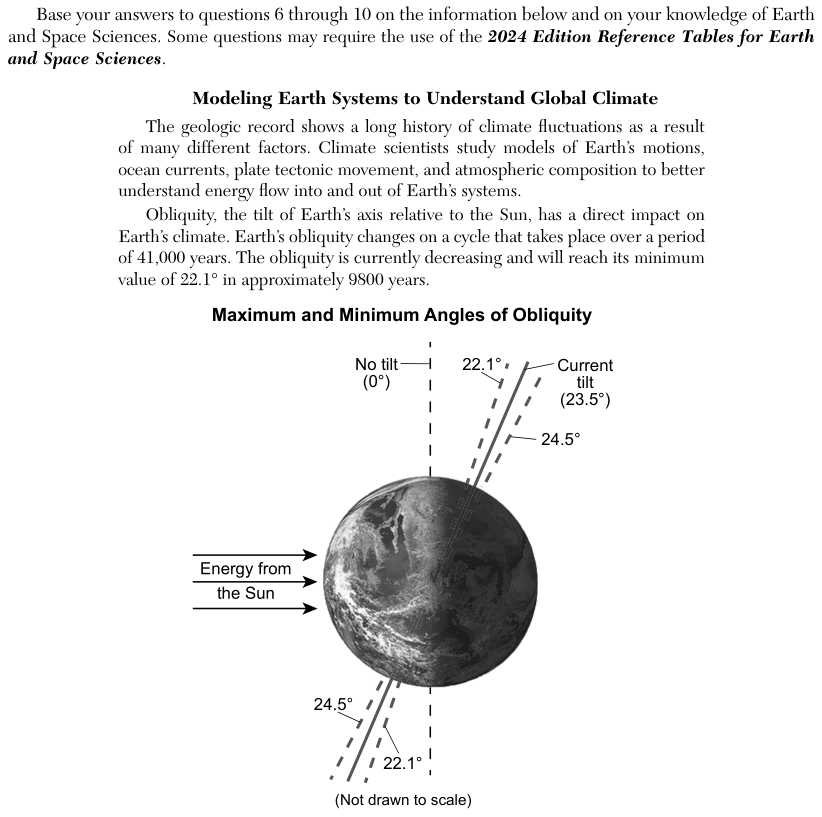
The passage explains that obliquity is the tilt of Earth's axis, that it changes on a cycle of about 41,000 years, and that it is now decreasing toward a minimum of 22.1 degrees, which it will reach in about 9800 years. The diagram "Maximum and Minimum Angles of Obliquity" shows Earth lit by energy from the Sun arriving from the left. Dashed and solid lines mark the axis with no tilt (0 degrees), the minimum tilt (22.1 degrees), the current tilt (23.5 degrees) and the maximum tilt (24.5 degrees). The diagram is not drawn to scale.
How to think about it
In the northern hemisphere's winter, the North Pole end of the axis points away from the Sun. Ask how the angle of sunlight at middle and high northern latitudes changes when the axis leans away by a smaller amount. Then think about what that change in energy means for how much ice forms in the cold season.
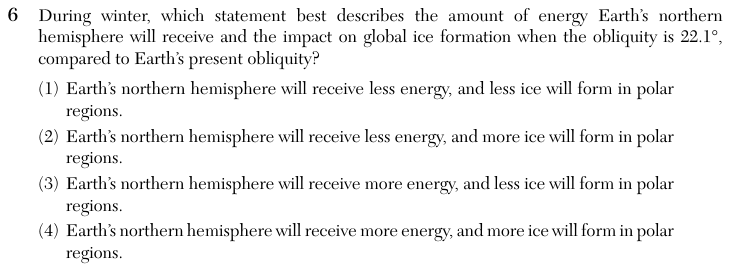
During winter, which statement best describes the amount of energy Earth’s northern hemisphere will receive and the impact on global ice formation when the obliquity is 22.1°, compared to Earth’s present obliquity?
Choice 3 is right. With a smaller tilt of 22.1 degrees, the northern hemisphere leans away from the Sun less during its winter. Sunlight strikes it at a higher angle, so each square meter of ground receives more energy. Winters become milder, so less ice forms in the polar regions during that season.
This choice gets the energy change backwards. A smaller tilt means the hemisphere leans away from the Sun less in winter, so it receives more energy, not less. Less energy would also lead to more ice, not less.
This choice describes what would happen with a larger tilt, such as 24.5 degrees. At 22.1 degrees the tilt is smaller than today, so the winter hemisphere receives more energy and forms less ice.
The energy part is correct, but the ice part does not follow from it. More energy in winter means milder temperatures, which reduces ice formation rather than increasing it.