Earth and Space Sciences Regents, June 2026, question 43
Tap an image to open it full size.
What the figure shows
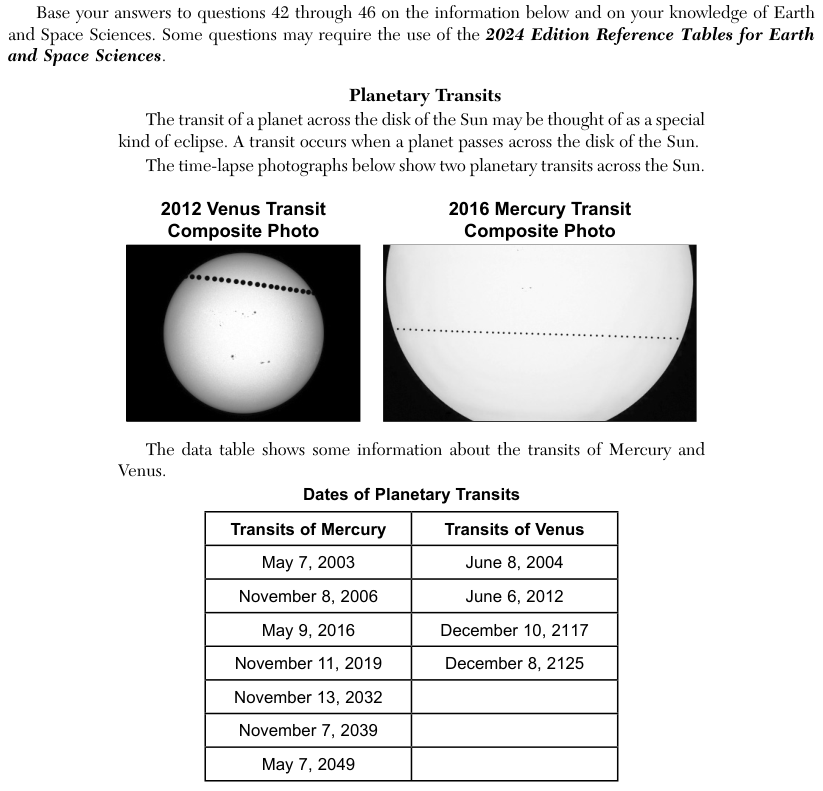
The passage, Planetary Transits, says a transit happens when a planet passes across the disk of the Sun. Two time-lapse photographs show the 2012 Venus transit and the 2016 Mercury transit. The data table, Dates of Planetary Transits, lists seven transits of Mercury from 2003 to 2049 and four transits of Venus: June 8, 2004; June 6, 2012; December 10, 2117; and December 8, 2125.
How to think about it
Each choice compares how fast two objects orbit the Sun. Open the Solar System Objects Data Table and find the period of revolution for Mercury, Venus and Earth. Divide the longer period by the shorter one for each pair named, and check which statement gives a correct comparison that also explains more transits.
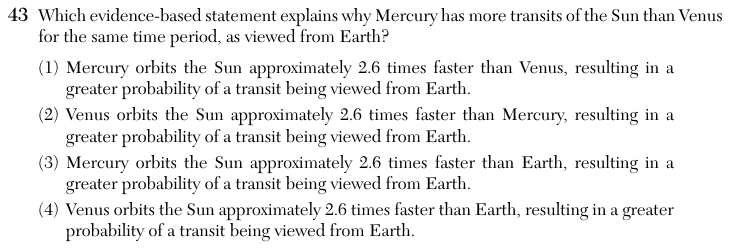
Which evidence-based statement explains why Mercury has more transits of the Sun than Venus for the same time period, as viewed from Earth?
Choice 1 is right. Mercury takes 88 Earth days to orbit the Sun and Venus takes 224.7 Earth days, and 224.7 divided by 88 is about 2.6. Mercury goes around the Sun about 2.6 times for each orbit of Venus. It passes between Earth and the Sun much more often, so it has more chances to line up for a transit.
This reverses the two planets. Venus takes 224.7 days to orbit, longer than Mercury's 88 days, so Venus is the slower planet.
Mercury does orbit faster than Earth, but by about 4.2 times (365.26 days divided by 88 days), not 2.6 times. This comparison also says nothing about why Mercury transits more often than Venus.
Venus orbits faster than Earth, but only by about 1.6 times (365.26 days divided by 224.7 days), not 2.6 times. It also does not compare Mercury with Venus, which is what the question asks.