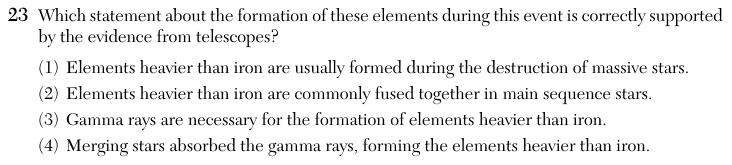
Earth and Space Sciences Regents, June 2026, question 23
Tap an image to open it full size.
What the figure shows
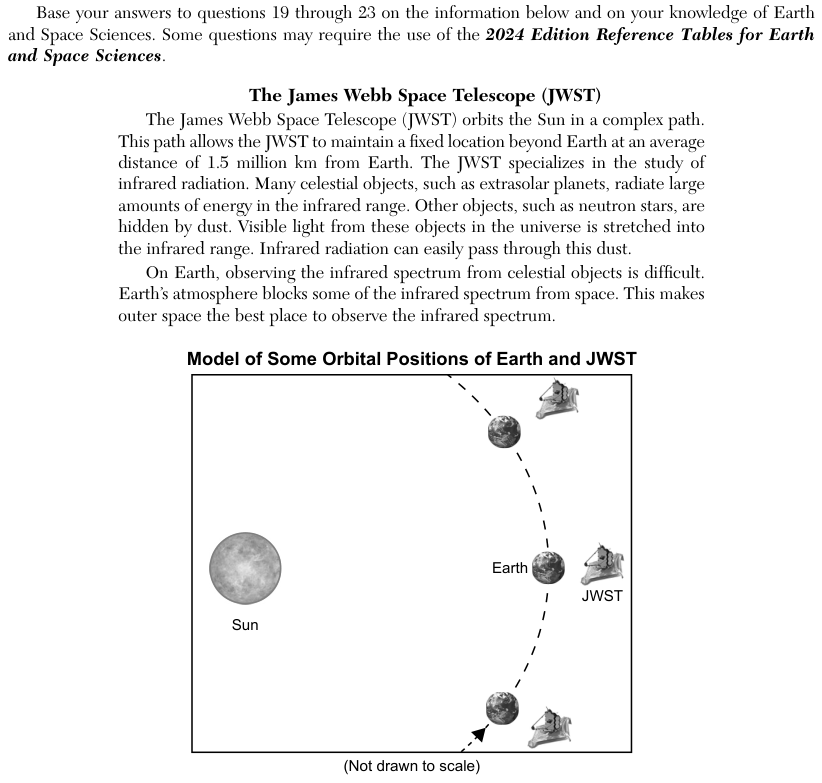
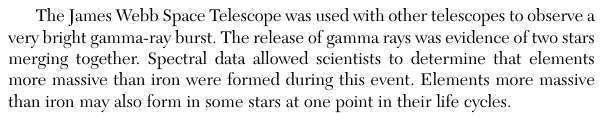
The passage says the James Webb Space Telescope was used with other telescopes to observe a very bright gamma-ray burst. The release of gamma rays was evidence of two stars merging together. Spectral data showed that elements more massive than iron were formed during this event. The passage adds that elements more massive than iron may also form in some stars at one point in their life cycles.
How to think about it
Open the Generalized Nucleosynthesis in a Massive Star diagram and find the heaviest element a star makes by ordinary fusion in its core, and what stage comes after it. Then reread the passage to see what kind of event produced the heavy elements, and what role the gamma rays played as evidence.
Which statement about the formation of these elements during this event is correctly supported by the evidence from telescopes?
Choice 1 is right. Fusion in a star's core builds elements only up to iron; the nucleosynthesis diagram ends at Fe, followed by core collapse. Some elements heavier than iron form inside evolved stars that are not being destroyed, by slow neutron capture, in which atomic nuclei take in neutrons one at a time. The rest form in violent events, such as some supernovas and the merging of two collapsed stars like the one in the passage. The telescopes saw these elements appear during the merger, which supports this statement.
Main sequence stars fuse hydrogen into helium. The nucleosynthesis diagram shows that even the most massive stars stop fusing at iron, so main sequence stars do not commonly make elements heavier than iron.
In the passage the gamma rays are evidence that two stars merged; they are given off by the event, not used to make the elements. This choice may come from mixing up the evidence for the event with its cause.
The passage says gamma rays were released by the merger, not absorbed by the stars. This choice reverses the direction of the energy flow.