Earth and Space Sciences Regents, June 2026, question 3
Tap an image to open it full size.
What the figure shows
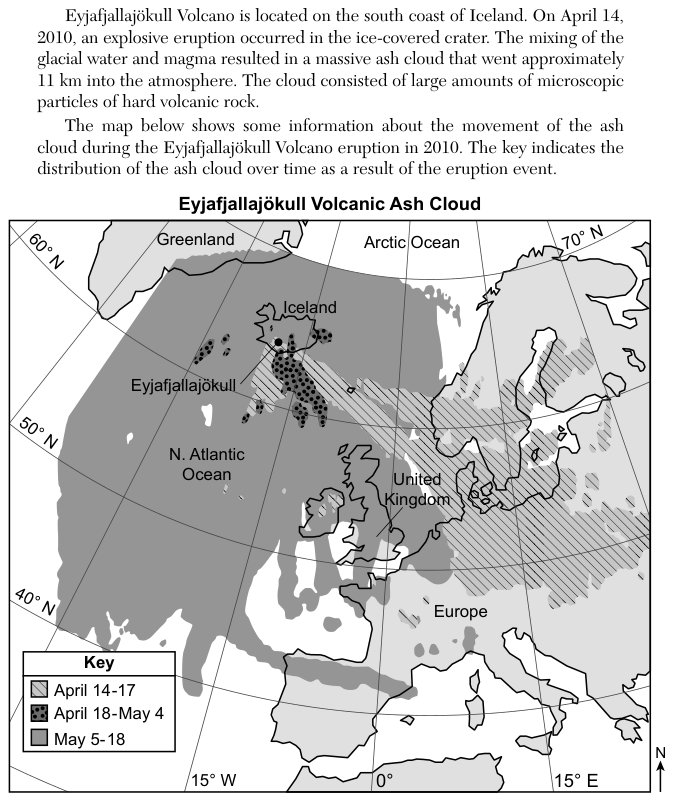
The passage says Eyjafjallajökull Volcano, on the south coast of Iceland, erupted explosively on April 14, 2010. Glacial water mixing with magma sent an ash cloud about 11 kilometers (km) into the atmosphere, made of microscopic particles of hard volcanic rock. The map Eyjafjallajökull Volcanic Ash Cloud covers Greenland, Iceland, the North Atlantic Ocean, the Arctic Ocean, the United Kingdom and Europe, and its key shows three patterns: diagonal lines for April 14-17, dots for April 18-May 4, and solid dark gray for May 5-18. On the map the diagonal lines run from Iceland southeast toward the United Kingdom and across northern Europe; the dots lie on Iceland and close to its south coast near the volcano; the dark gray covers a wide area of the North Atlantic, including all of Iceland, and reaches the British Isles and parts of western Europe.
How to think about it
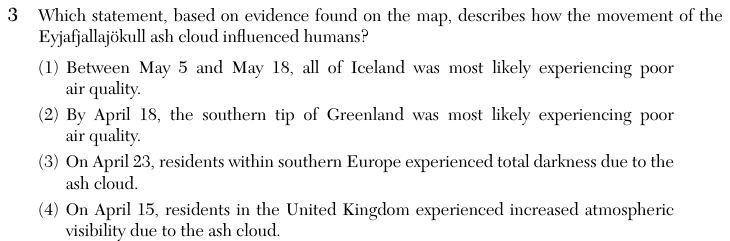
Each statement names a date or a date range and a place. Find which key pattern matches that date, then check on the map whether that pattern covers that place. Also check whether the effect on people that the statement describes is something a cloud of fine rock particles in the air would cause.
Which statement, based on evidence found on the map, describes how the movement of the Eyjafjallajökull ash cloud influenced humans?