Earth and Space Sciences Regents, January 2026, question 11
Tap an image to open it full size.
What the figure shows
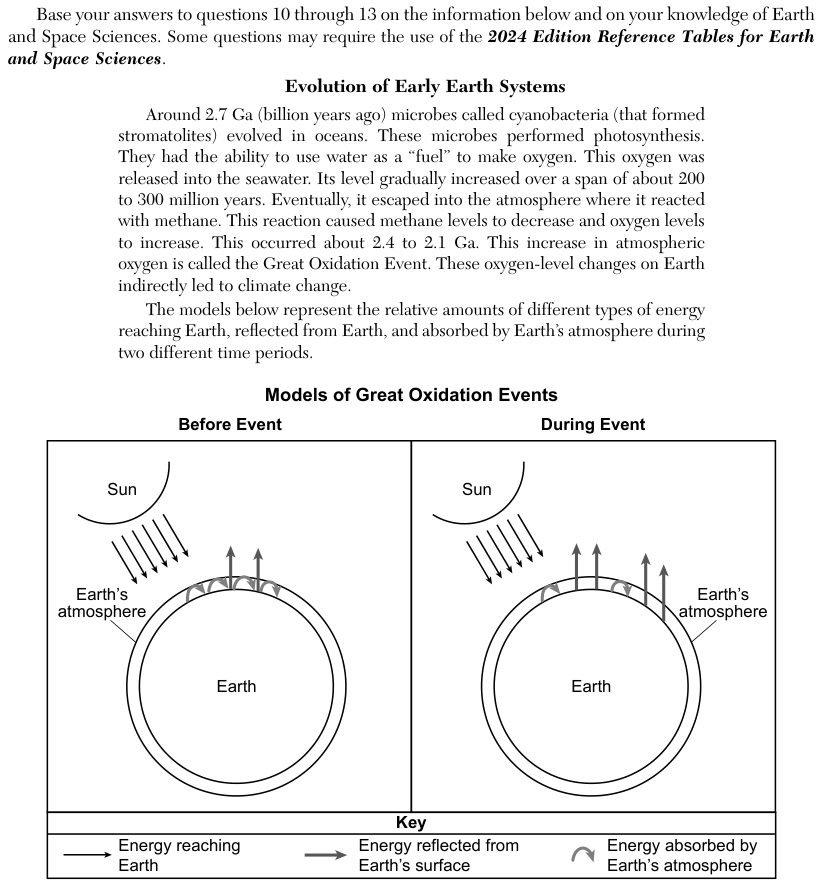
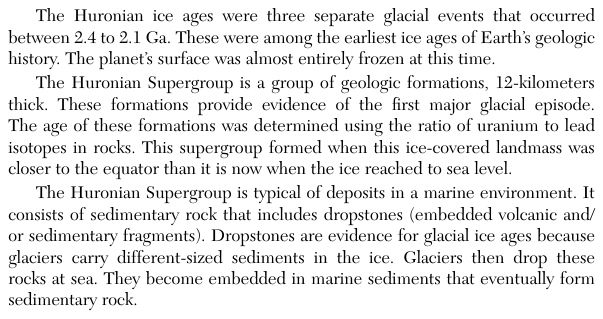
The passage says the Huronian ice ages were three glacial events between 2.4 and 2.1 Ga (billion years ago). It states that the age of the Huronian Supergroup formations was determined using the ratio of uranium to lead isotopes in rocks. The Huronian Supergroup is marine sedimentary rock that contains dropstones, fragments carried by glaciers and dropped at sea.
How to think about it
Find the sentence in the passage that says what was measured in the rocks to find their age. Then read each choice and check which one describes that same method.
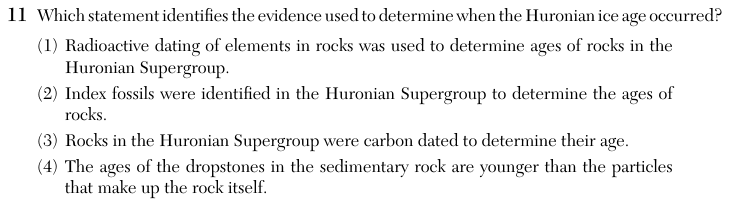
Which statement identifies the evidence used to determine when the Huronian ice age occurred?
Choice 1 is right. The passage says the ages were found from the ratio of uranium to lead isotopes. Uranium-238 decays to lead-206 with a half-life of 4.5 billion years, and the table gives it a useful range of 10 million to 4.6 billion years. That range covers rocks 2.4 to 2.1 billion years old.
The passage names the ratio of uranium to lead isotopes in the rocks as the dating evidence, not fossils. Nothing in the passage says index fossils were used to find the ages.
Carbon-14 has a half-life of 5730 years and the table gives its useful range as 100 to 70,000 years. Rocks over 2 billion years old are far beyond that range, and carbon dating is used on organic material, not on whole rock.
Comparing fragments inside a rock gives at most an order of events, not an age in years. Dropstones are pieces of older rock carried by ice, so neither the dropstones nor the other particles record when the rock itself formed. This choice may come from mixing up dropstones, which show that glaciers existed, with the method used to date the rocks.