Earth and Space Sciences Regents, August 2025, question 41
Tap an image to open it full size.
What the figure shows
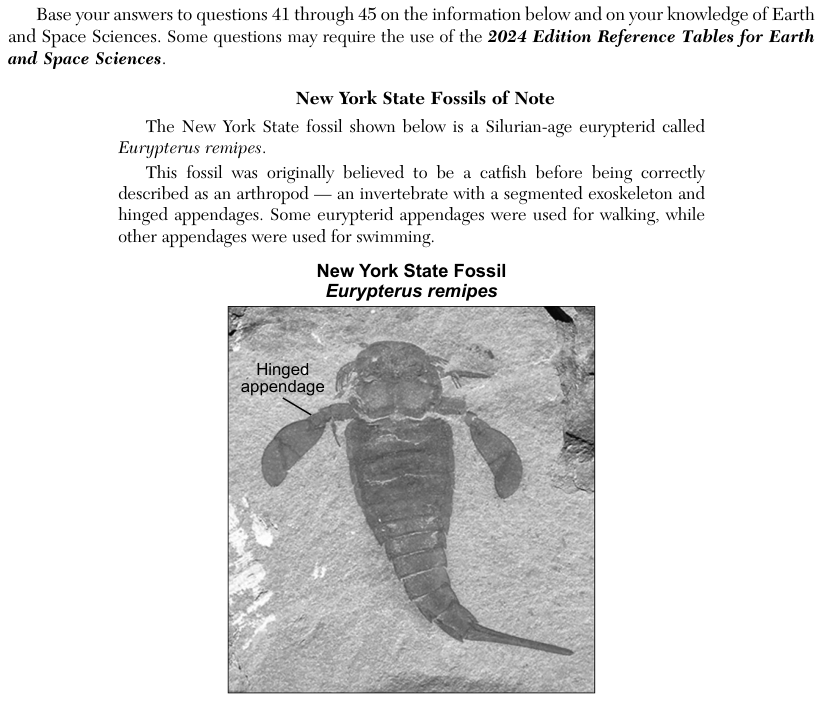
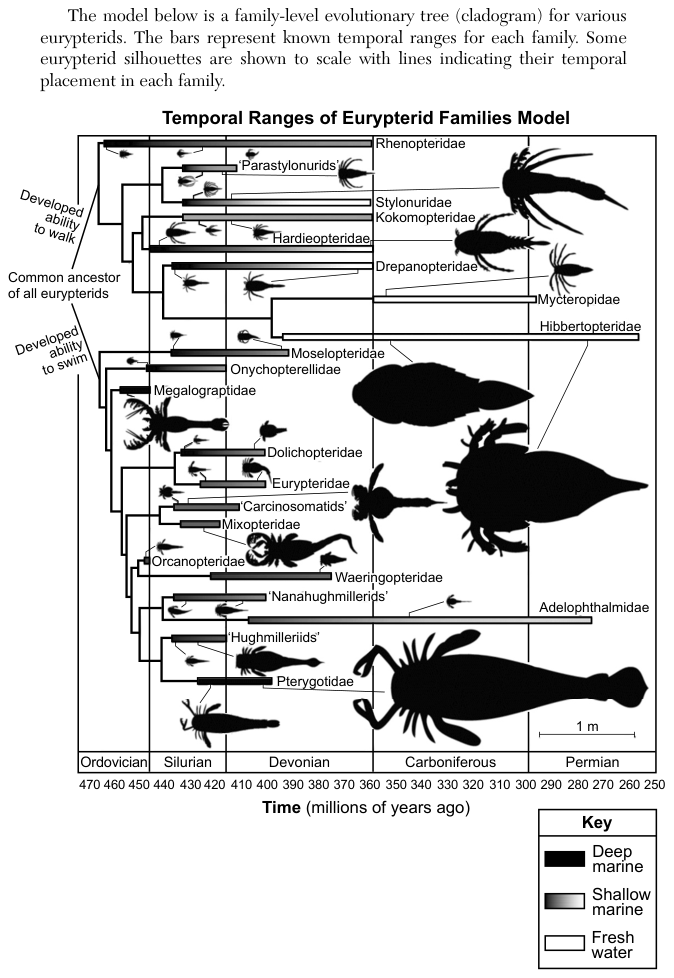
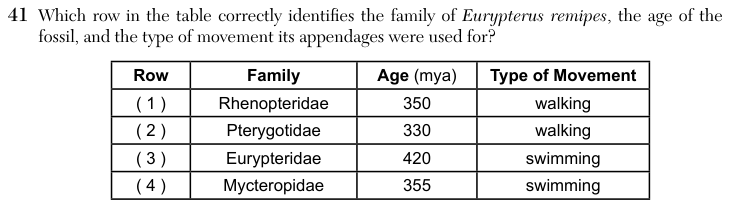
The passage says that the New York State fossil Eurypterus remipes is a Silurian-age eurypterid, an arthropod with hinged appendages, and that some eurypterid appendages were used for walking while others were used for swimming. A photograph shows the fossil with a hinged appendage labelled. A cladogram, Temporal Ranges of Eurypterid Families Model, shows bars for the time range of each family on an axis from 470 to 250 million years ago (mya), with the periods Ordovician, Silurian, Devonian, Carboniferous and Permian marked. One branch is labelled Developed ability to walk and the other Developed ability to swim. The upper group of families includes Rhenopteridae and Mycteropidae; the lower group includes Eurypteridae and Pterygotidae. The choices are a table of four rows giving a family, an age in mya, and a type of movement.
How to think about it
Use the genus name to find the matching family on the cladogram. Follow that family's line back to see which labelled branch it belongs to, walking or swimming. Then read where its bar sits on the time axis and check the age against the period named in the passage.
Which row in the table correctly identifies the family of Eurypterus remipes, the age of the fossil, and the type of movement its appendages were used for? Row Family Age (mya) Type of Movement
Choice 3 is right. The genus Eurypterus belongs to the family Eurypteridae. On the cladogram Eurypteridae sits in the group labelled Developed ability to swim, so its appendages were used for swimming. Its bar runs from about 425 to about 400 mya, and 420 mya falls in the Silurian Period, which matches the passage.
Rhenopteridae is a different family in the walking group. An age of 350 mya is in the Carboniferous Period, not the Silurian, and it falls shortly after the Rhenopteridae bar ends. This choice may come from picking a family in the walking group because the passage says some eurypterid appendages were used for walking.
Pterygotidae is a different family, and it is in the swimming group, not the walking group. An age of 330 mya is in the Carboniferous Period, long after the Pterygotidae bar ends. This choice may come from matching the word walking in the passage without following the Pterygotidae line back to its labelled branch.
Mycteropidae is a different family, and it sits in the walking group. An age of 355 mya is in the Carboniferous Period, not the Silurian Period named in the passage. This choice may come from choosing the right type of movement without matching the genus name Eurypterus to its family.