Earth and Space Sciences Regents, August 2025, question 28
Tap an image to open it full size.
What the figure shows
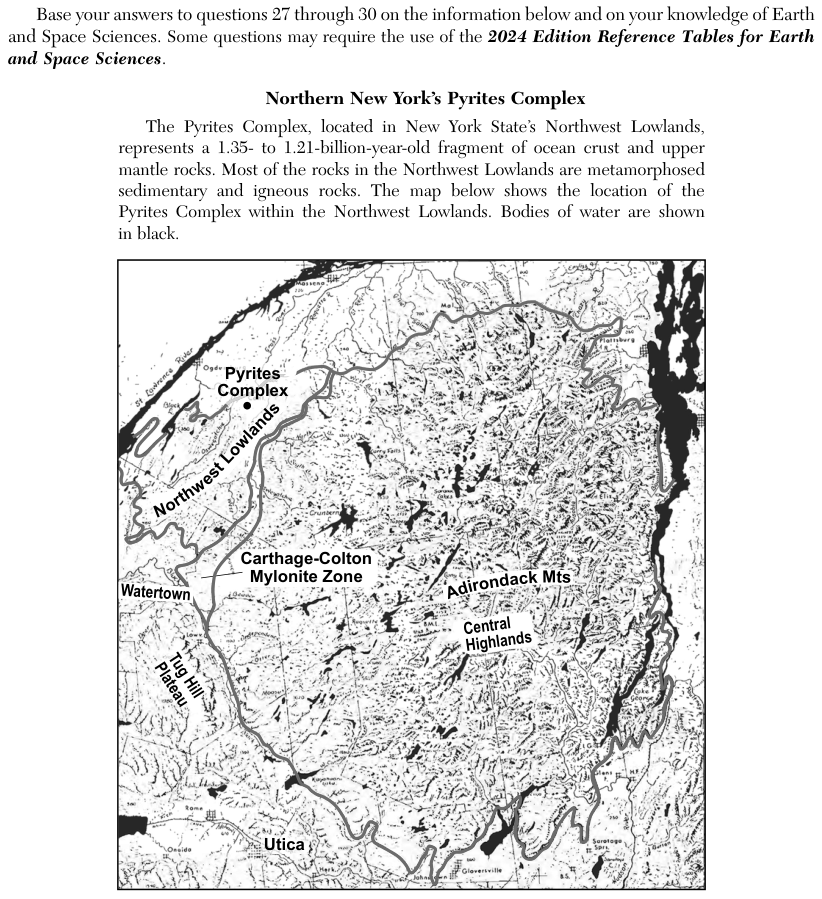
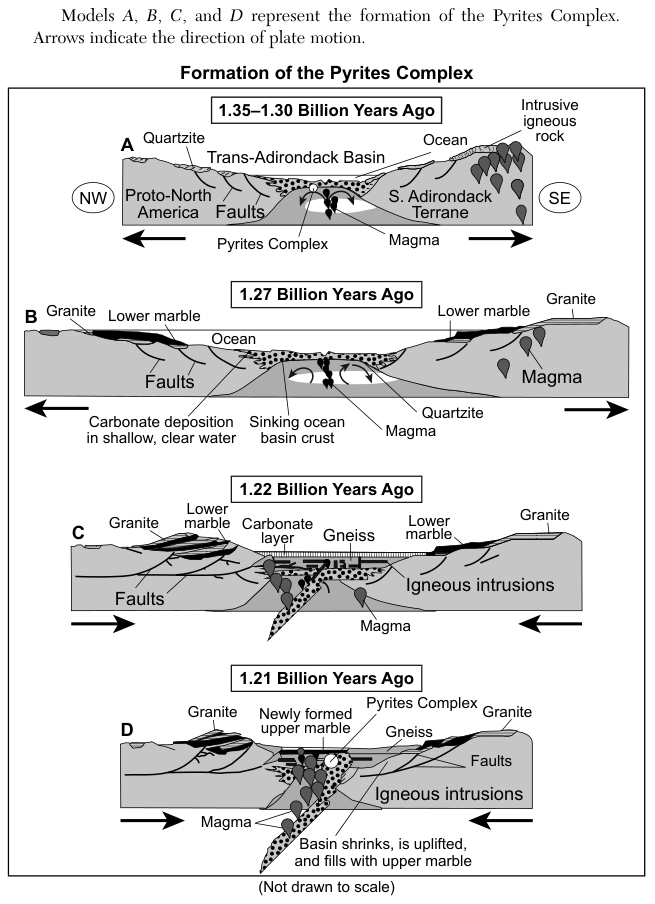
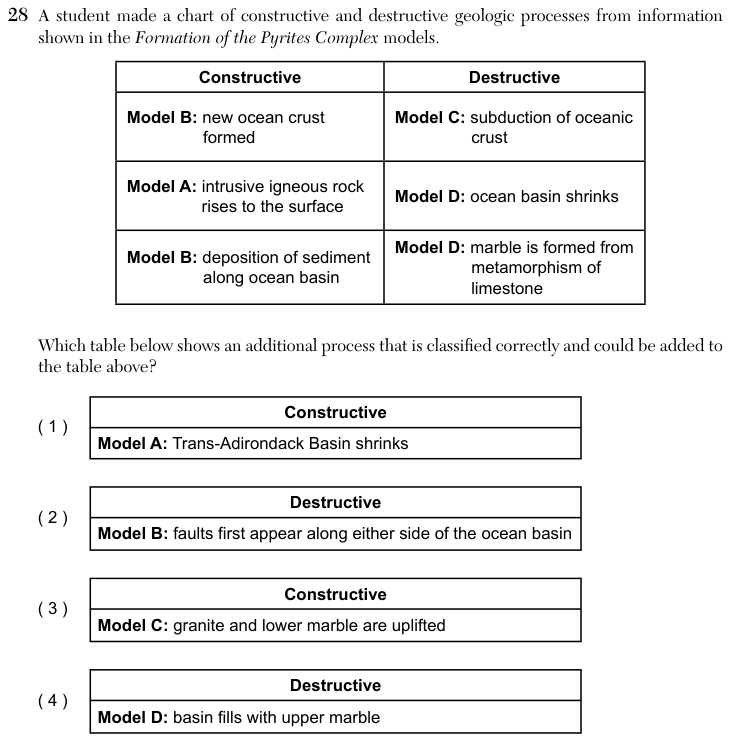
The Formation of the Pyrites Complex models show a cross section at four times, from northwest (NW) to southeast (SE). Model A (1.35 to 1.30 billion years ago): arrows point away from each other; faults, quartzite and the Trans-Adirondack Basin with ocean; magma rising under the Pyrites Complex; intrusive igneous rock in the South (S.) Adirondack Terrane. Model B (1.27 billion years ago): arrows point apart; granite and lower marble on both sides, faults, carbonate deposition in shallow, clear water, sinking ocean basin crust, quartzite and magma. Model C (1.22 billion years ago): arrows point toward each other; granite and lower marble raised on the sides, a carbonate layer, gneiss, igneous intrusions and magma. Model D (1.21 billion years ago): arrows point toward each other; newly formed upper marble, the Pyrites Complex, gneiss, faults, igneous intrusions, magma, and the label Basin shrinks, is uplifted, and fills with upper marble. The question shows a student's chart with Constructive and Destructive columns, and four one-row tables, each giving a model, a process and a column heading.
How to think about it
For each of the four tables, first find the named model and check that the process is really shown there. Then read the student's chart to see which processes are already listed under Constructive and which under Destructive. Last, check whether the heading in the table sorts the new process in the same way as the student's chart.
A student made a chart of constructive and destructive geologic processes from information shown in the Formation of the Pyrites Complex models. Constructive Destructive Model B: new ocean crust formed Model C: subduction of oceanic crust Model A: intrusive igneous rock rises to the surface Model D: ocean basin shrinks Model B: deposition of sediment along ocean basin Model D: marble is formed from metamorphism of limestone Which table below shows an additional process that is classified correctly and could be added to the table above? Model A: Trans-Adirondack Basin shrinks Constructive Model B: faults first appear along either side of the ocean basin Destructive Model C: granite and lower marble are uplifted Constructive Model D: basin fills with upper marble Destructive