Earth and Space Sciences Regents, June 2025, question 2
Tap an image to open it full size.
What the figure shows
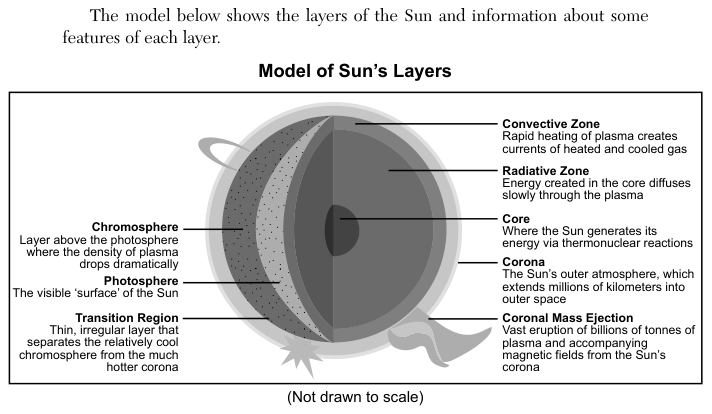
A cutaway drawing titled "Model of Sun's Layers" shows the Sun as nested layers around a small central core, with a label and a short description for each layer. The labels are core, radiative zone, convective zone, photosphere, chromosphere, transition region and corona. The descriptions say, for example, that the core is where the Sun makes its energy by thermonuclear reactions, that energy diffuses slowly through the radiative zone, that the convective zone has currents of heated and cooled gas, and that the photosphere is the visible surface. A coronal mass ejection is also labelled at the outer edge. The drawing is not to scale.
How to think about it
Start at the center, where the energy is made, and follow it outward one layer at a time. Use the description printed beside each label: some layers are inside the Sun, one is the visible surface, and some lie above the surface as the Sun's atmosphere. A correct sequence must pass through every inner layer, in order, before it reaches the surface.
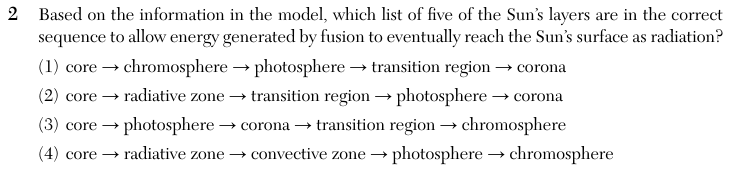
Based on the information in the model, which list of five of the Sun’s layers are in the correct sequence to allow energy generated by fusion to eventually reach the Sun’s surface as radiation?
Choice 4 is right. Fusion energy is made in the core. It moves slowly outward through the radiative zone, then is carried upward by rising and sinking gas in the convective zone. It reaches the photosphere, the visible surface, and leaves as radiation. The chromosphere is the next layer, which the model describes as the layer above the photosphere.
This list skips the radiative and convective zones, which the energy must cross before it reaches the photosphere. It also puts the chromosphere below the photosphere, although the model says the chromosphere lies above it.
This list leaves out the convective zone and puts the transition region inside the Sun, below the photosphere. The model places the transition region in the atmosphere, between the chromosphere and the corona.
This list jumps from the core straight to the photosphere, leaving out both interior zones. It also reverses the outer layers: the chromosphere is closest to the photosphere and the corona is the outermost layer.